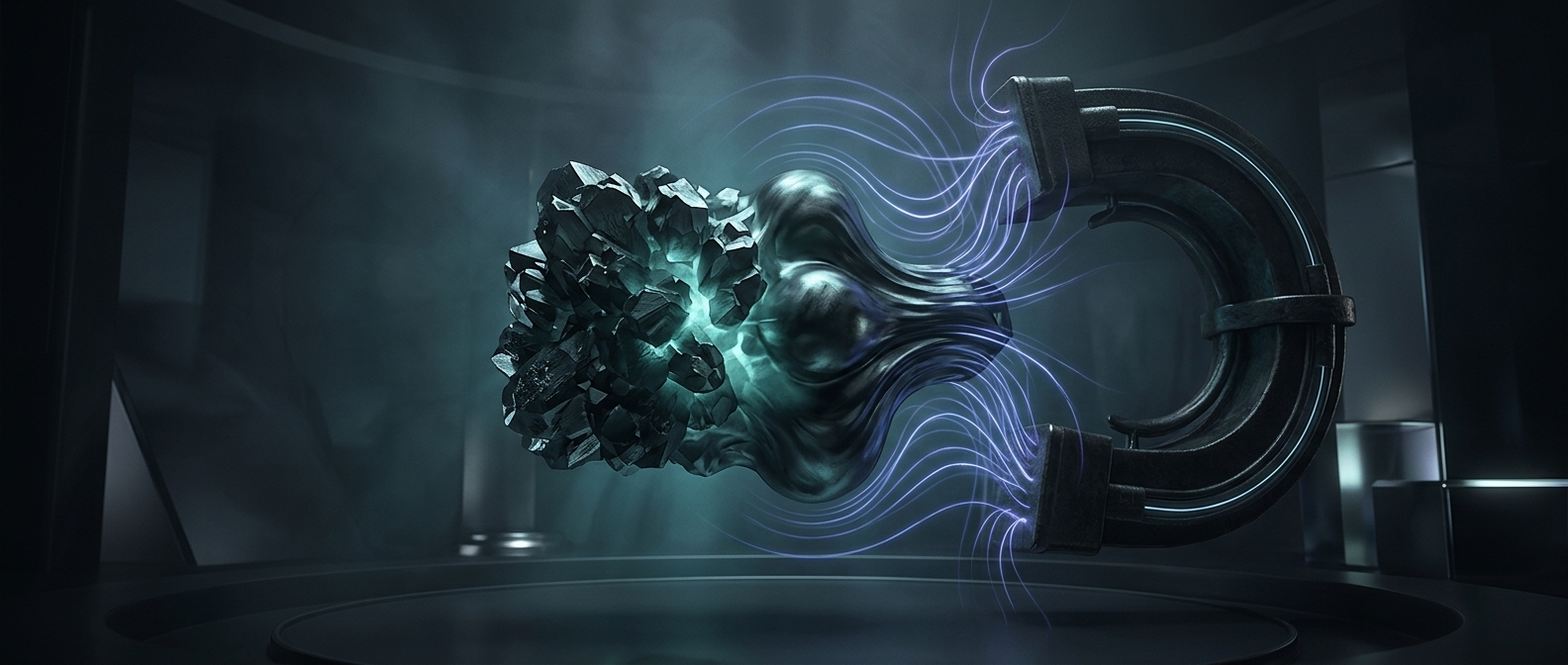
The Curie point is a change in magnetic order
Gadolinium’s shift near room temperature is an example of a Curie point: the temperature at which a ferromagnet loses its spontaneous, large-scale magnetic order. Below that point, neighboring atomic magnetic moments favor lining up. The material organizes into regions called magnetic domains, each with a strong net magnetization.
Heating does not switch off the atoms’ magnetic moments. Instead, thermal motion increasingly disrupts their shared alignment. Near gadolinium’s Curie point—about 20°C—the ordered state gives way to a paramagnetic one. Above it, the moments are much less coordinated, though an external magnetic field can still make them respond weakly.
Why a small temperature change matters
The change is not a matter of a room being simply “warm” or “cold”: the result depends on the metal’s actual temperature, which can differ from the surrounding air. Nor is magnetism a binary property. Near the transition, the strength of the response changes sharply, while the material remains responsive to a sufficiently strong field.
That temperature-sensitive rearrangement also gives gadolinium a useful feature: its magnetic order changes readily under conditions close to everyday temperatures. When a magnetic field is applied or removed, the rearrangement can alter the metal’s temperature—a behavior known as the magnetocaloric effect. Researchers investigate this effect for magnetic cooling, where changing a field can move heat without relying on a conventional expanding refrigerant gas.
So the striking point is not that gadolinium becomes wholly nonmagnetic in a warm room. A few degrees can instead move it across a boundary between collective alignment and mostly uncoordinated atomic moments.