Why a magnet can reshape terbium
The key is that magnetism and the arrangement of atoms are not independent in terbium. Each atom carries a tiny magnetic moment, and terbium’s electrons also help determine how strongly the crystal is spaced in different directions. When a magnetic field changes the moments’ alignment, it changes the forces holding the crystal lattice—the orderly pattern of atoms—in place.
That effect is called magnetostriction: a material changes dimensions when magnetized. The change in any one atomic spacing is extremely small. But the crystal contains vast numbers of atoms, so their coordinated shifts can add up to a measurable change across a piece of metal.
A microscopic push, repeated throughout the crystal
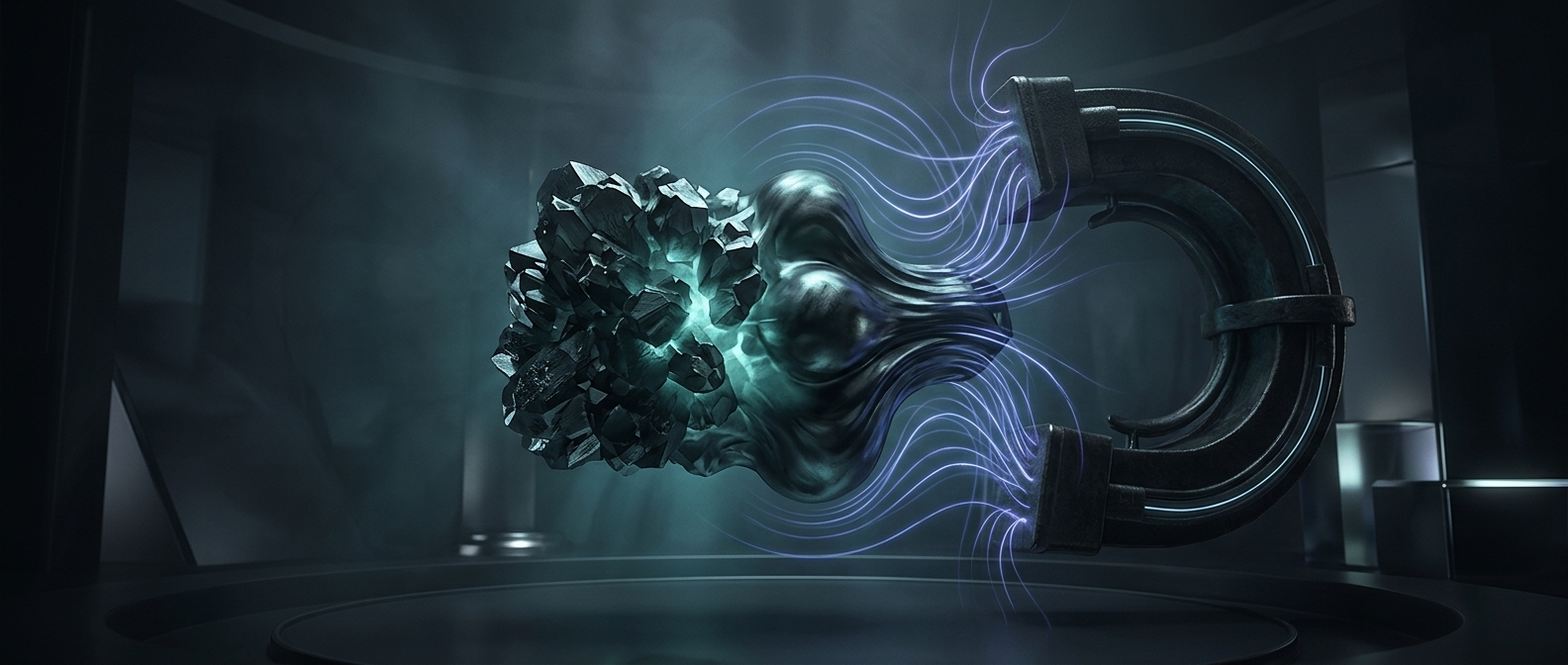
Picture a row of atoms whose spacing changes by only a tiny amount. One such change is invisible; repeated across the material, it alters the length or shape of the whole piece. The magnet does not simply pull the metal toward itself like an iron filing. Instead, it changes the internal magnetic arrangement, and the crystal responds by adjusting its dimensions.
The effect depends on how the field is oriented relative to the crystal, because the atomic arrangement is not equally responsive in every direction. That makes terbium a striking example of a broader principle: a magnetic field can do mechanical work by rearranging a material from within. In specialized devices, related magnetostrictive materials turn changing magnetic fields into motion; terbium’s small atomic shifts are the same kind of bridge between magnetism and movement.