A Fist Becomes a Special Effect
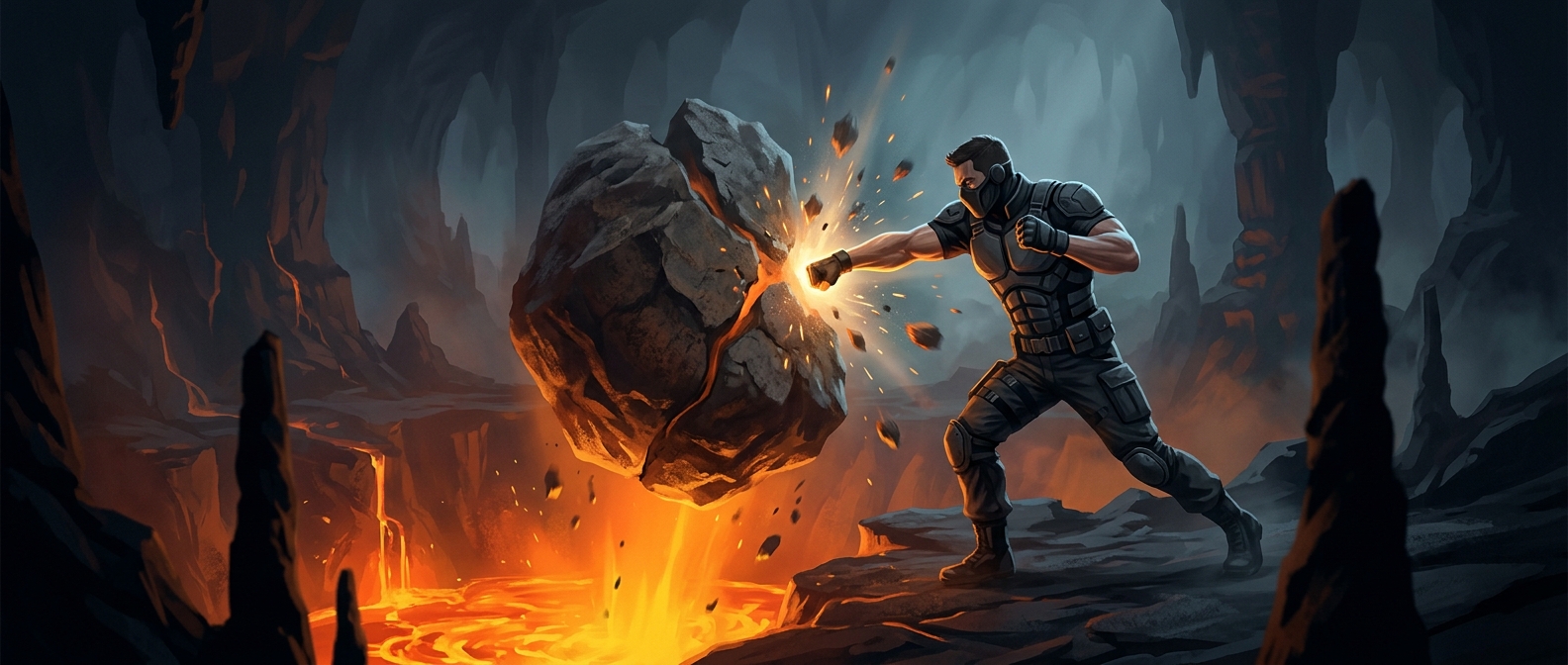
A person could not punch a house-sized boulder into motion with bare hands. The scene works because it borrows the visual grammar of a game: the hero’s body is treated less like a real body and more like a tool for producing an unmistakable result. One blow, one huge movement, and the audience instantly understands who has the advantage.
The rock’s size does much of the storytelling. It makes an ordinary punch look consequential without needing an explanation of the hero’s strength. The lava supplies urgency and spectacle: once the boulder moves, its destination is obvious, and the danger is visible in the same frame.
Why Make the Impossible So Clear?
Games often have to communicate action quickly. In a fast-moving scene, a small or complicated effect can be hard to read; a gigantic object shifting toward a glowing pool of magma is not. The exaggeration turns a fight into a simple visual sequence: obstacle, impact, consequence.
That clarity comes at the cost of realism. A real boulder’s mass would make it extraordinarily difficult to move, and a bare fist would be badly injured long before it could deliver the force shown. But the scene is not asking viewers to calculate impact physics. It is using impossible strength as shorthand for a hero who has crossed from human capability into comic-book spectacle.
The memorable detail is the contrast: the fist is tiny beside the rock, yet the rock obeys it. That single image makes the hero’s power legible without a number, a speech, or a tutorial.