Why the Chinese zodiac has twelve animals
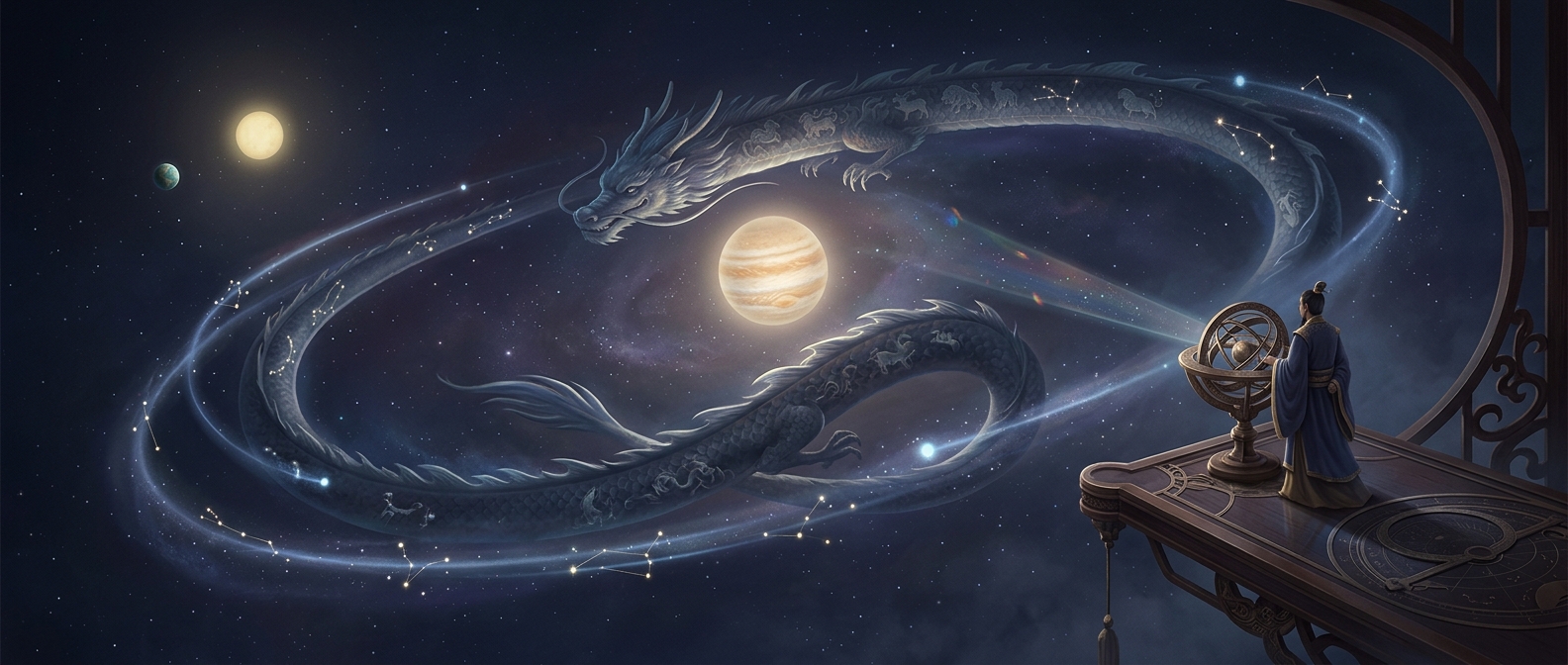
The zodiac’s twelve-year rhythm has a close astronomical counterpart: Jupiter takes about 11.86 years to orbit the Sun. In ancient Chinese astronomy, Jupiter was known as the “Year Star,” and its slow movement across the sky offered a way to track time on an approximately twelve-year cycle. The zodiac’s twelve animals are associated with that cycle through the twelve earthly branches, a traditional system for marking years as well as hours and directions.
The match is close, not exact. Zodiac years follow the Chinese lunisolar calendar, whose months are based on the Moon and whose timing is adjusted to stay aligned with the seasons. A zodiac year therefore does not begin when Jupiter completes a precise orbit; it begins at the calendar’s New Year, which falls on a different date in the Gregorian calendar from one year to the next.
A repeating calendar, not a monthly Sun cycle
The Sun’s apparent yearly journey helps mark the seasons, while the Moon’s phases shape the months. The animal sign answers a different question: which year in the repeating twelve-year sequence is it? Each year gets one animal, and after the twelfth, the sequence starts again.
That pattern is only one layer of traditional Chinese astrology. The animals combine with other calendar elements in longer cycles, so the same animal returns with different associations over time. Jupiter helps explain why twelve became a meaningful span, but the familiar animal year is ultimately a calendrical designation—not a direct reading of Jupiter’s exact position.