Steering a ship is not like turning a car
A car’s steering wheel is mechanically linked to its front wheels: turn the wheel, and the tires pivot. On a cruise ship, the bridge controls send commands to powered equipment instead. That distinction matters because a ship’s rudder sits far behind the bridge, underwater, and may need substantial force to redirect the vessel.
The captain’s controls tell steering machinery how far to move the rudder. Water flowing past the angled rudder then pushes the stern sideways, changing the ship’s heading. The command is small; the force that carries it out comes from the machinery and the water, not from the captain’s arms.
Different controls handle different jobs
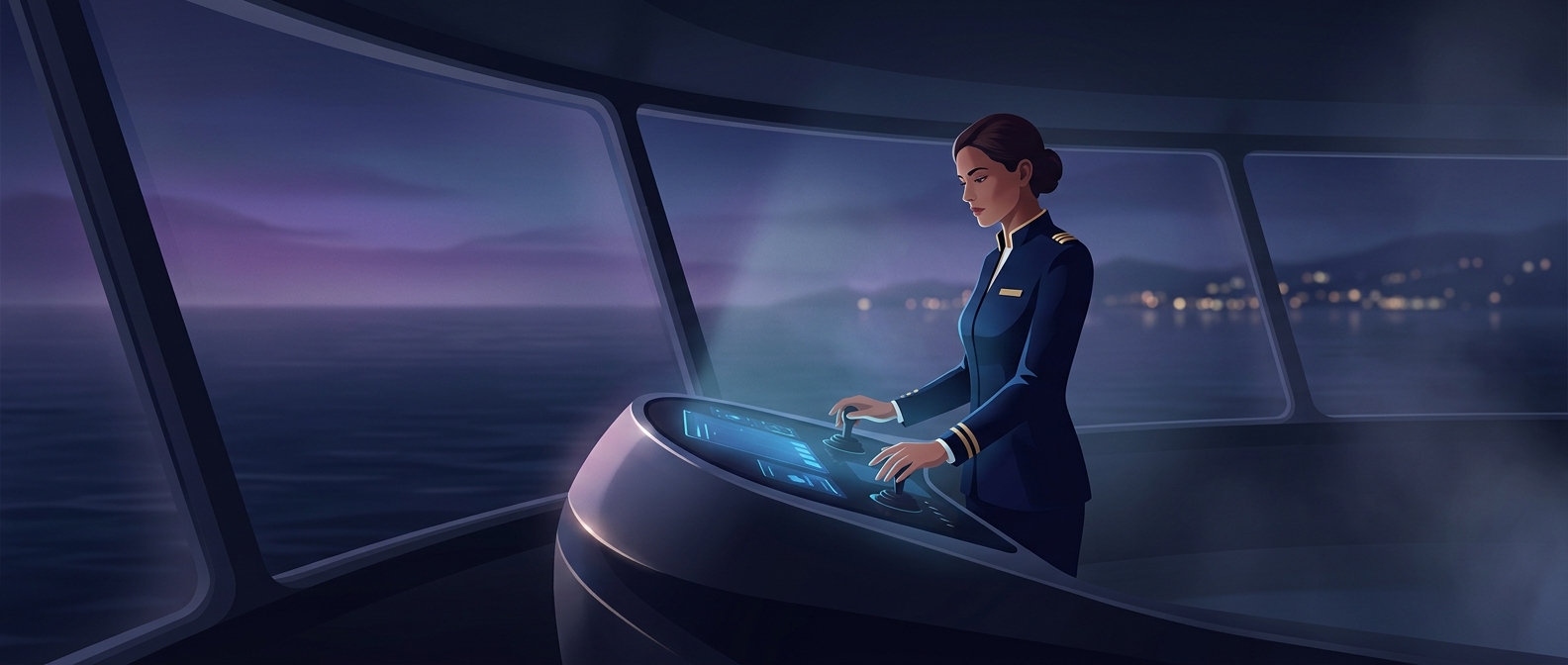
A lever or joystick can make precise changes to the rudder without requiring a wheel to rotate through a large arc. Separate controls may operate bow thrusters—powerful sideways-facing propellers near the front of the ship. They push the bow laterally, especially useful when maneuvering slowly in a harbor, where the rudder has less water flow to work with.
These controls do not make a huge ship turn instantly. Its mass and momentum mean that a heading change takes time, and the bridge team must account for the ship’s speed, wind, current, and surrounding traffic. A small input can begin a maneuver, but the vessel’s response unfolds over distance.
Why a wheel is unnecessary
A steering wheel is useful when a person’s movement directly positions wheels or when a familiar, continuous hand control suits the task. A modern ship instead benefits from controls that command powered systems and can be adjusted independently for different maneuvers. The bridge is therefore less like a driver’s seat and more like a control station: the operator chooses the desired action, and machinery applies the force.
That is why a cruise ship can be steered without a wheel—and why a modest joystick movement can ultimately redirect a vessel long enough to carry a floating neighborhood.