How the planets set the week’s rhythm
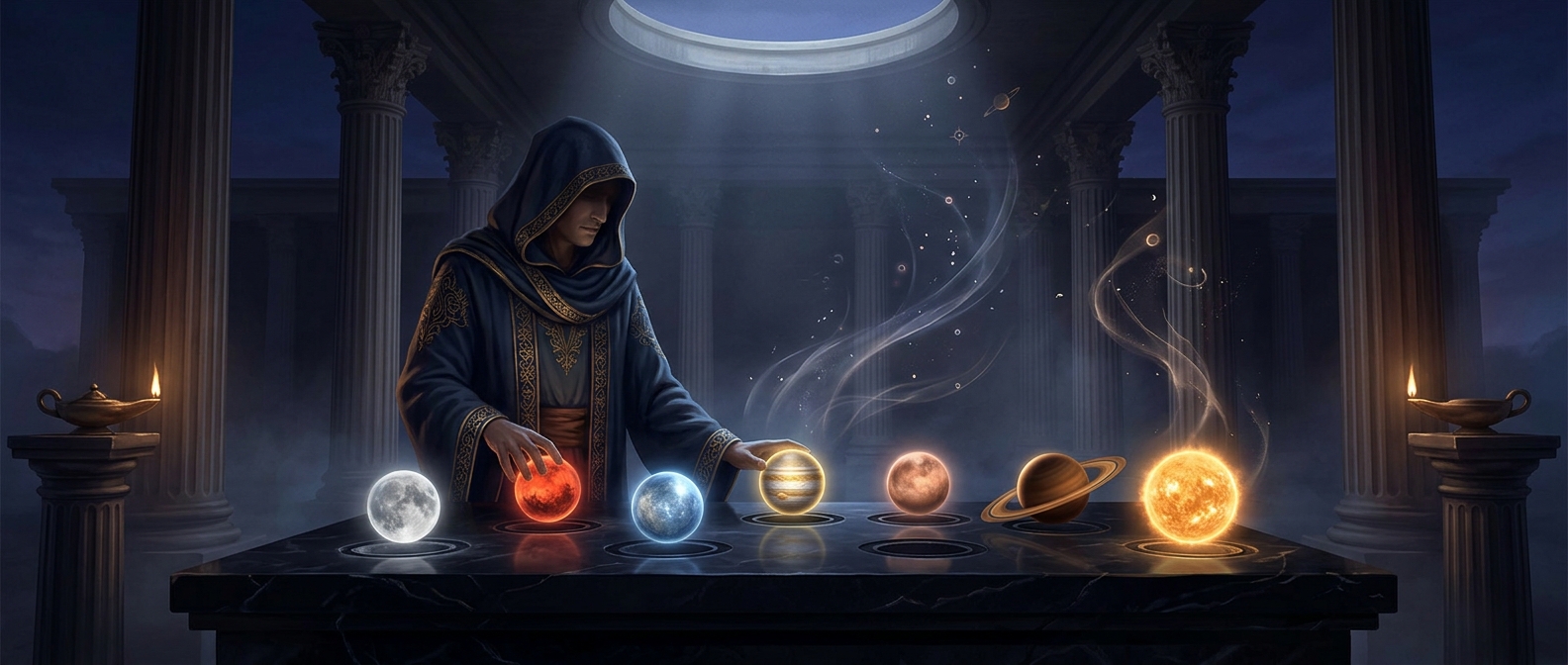
The seven-day week links each day to one of the seven “planets” known to ancient sky-watchers: Saturn, Jupiter, Mars, the Sun, Venus, Mercury, and the Moon. In this old usage, “planets” meant the wandering lights in the sky, including the Sun and Moon—not just the planets recognized by modern astronomy.
A Hellenistic astrological scheme assigned each hour to a planet in a repeating cycle. The order ran from Saturn through Jupiter, Mars, the Sun, Venus, Mercury, and the Moon, then started again. To name a day, astrologers looked to the planet assigned to its first hour. Because a day contains 24 hours, the first planet of the next day falls three places farther along the cycle. Repeat that step, and the sequence of day rulers emerges: Saturn, Sun, Moon, Mars, Mercury, Jupiter, Venus.
Roman names, Germanic gods
Romans used names based on those planetary rulers: dies Martis was Mars’s day, for example, while dies Iovis was Jupiter’s. As the week’s naming system spread among Germanic-speaking peoples, some Roman gods were matched with local gods thought to play comparable roles. Jupiter’s day became Thursday, named for Thor, a thunder god; Mars’s day became Tuesday, associated with Tiw.
The result is a calendar that preserves two layers of cultural history. English keeps the names of Germanic gods for several days, while Wednesday and Saturday reflect Woden and Saturn, and Sunday and Monday retain the Sun and Moon. The planets did not determine the week through any physical force: their sequence came from an astrological way of organizing time. But each time someone says “Thursday,” the old pairing of Thor and Jupiter still echoes in the name.