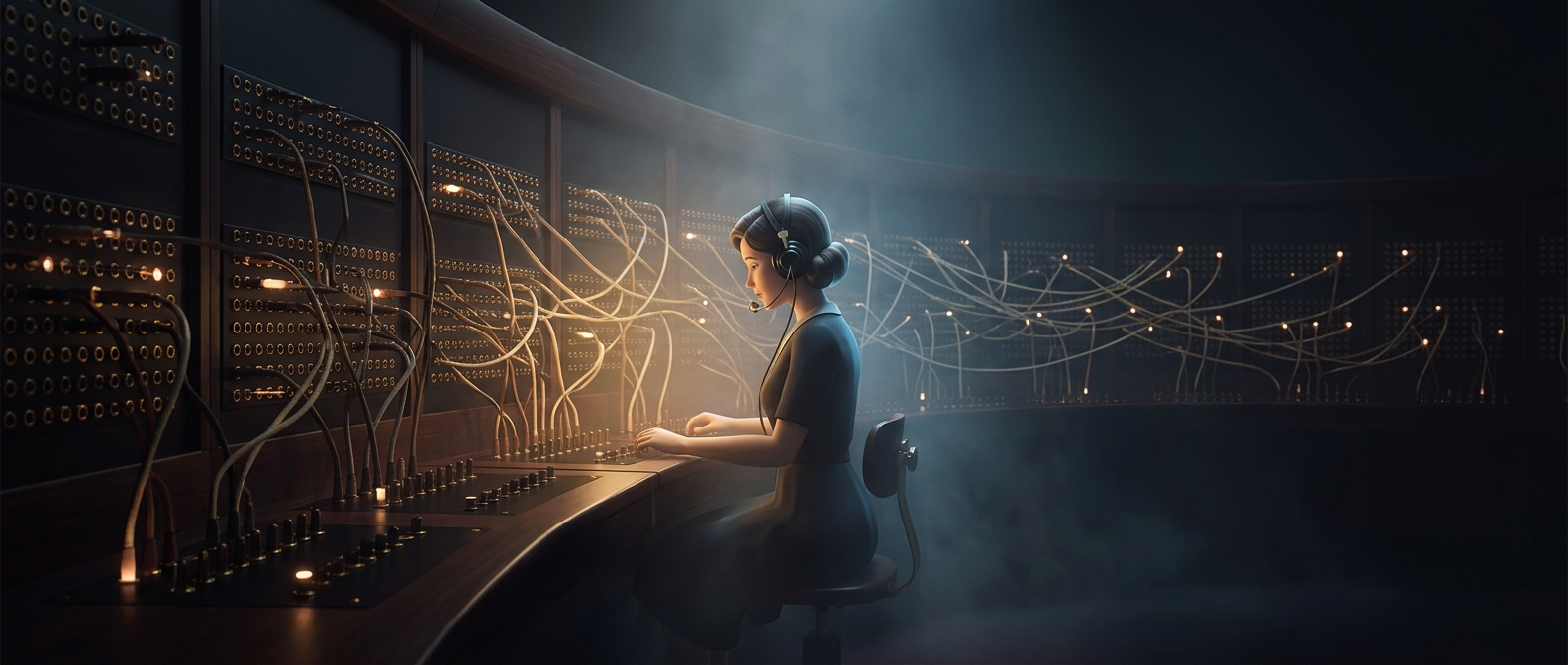
How an operator completed a call
In an early telephone exchange, a caller’s line ended at a central switchboard rather than connecting automatically to another subscriber. When a call came in, the operator answered and asked which person or business the caller wanted. The operator then found that destination’s socket—called a jack—on the board.
A flexible cord with a plug at its end linked the two lines: one plug went into the caller’s connection, and the other into the requested subscriber’s jack. That physical link completed an electrical path between the telephones. The operator could then signal the other end so the recipient knew a call was waiting.
Why the switchboard mattered
The board was a human-operated switching system. Instead of machinery identifying a destination and routing a call, an operator interpreted the request and made the connection by hand. A busy destination might require a different response, while a completed call had to be disconnected so the lines and cords could be used again.
This arrangement made the exchange a shared hub: many subscribers’ lines converged there, and each call occupied a temporary connection through it. As the number of customers grew, operators and switchboards had to handle more requests and connections. The basic task—linking one caller to one destination—was simple, but it had to be repeated for every call. A conversation began not with a direct connection between neighbors, but with someone at the exchange physically joining their lines.