A world built one chunk at a time
Minecraft’s enormous map is not a single, fully drawn landscape. The game creates terrain as players approach it, using rules that turn a location’s coordinates into features such as hills, caves, rivers, and biomes. The result is a world that can keep unfolding without requiring every distant region to be stored in advance.
The terrain is divided into chunks—small, fixed sections the game can generate and manage independently. As a player travels, nearby chunks appear; faraway ones need not be active. That system makes a landscape on a planetary scale practical to explore, even though no player can see or load all of it at once.
Turning blocks into distance
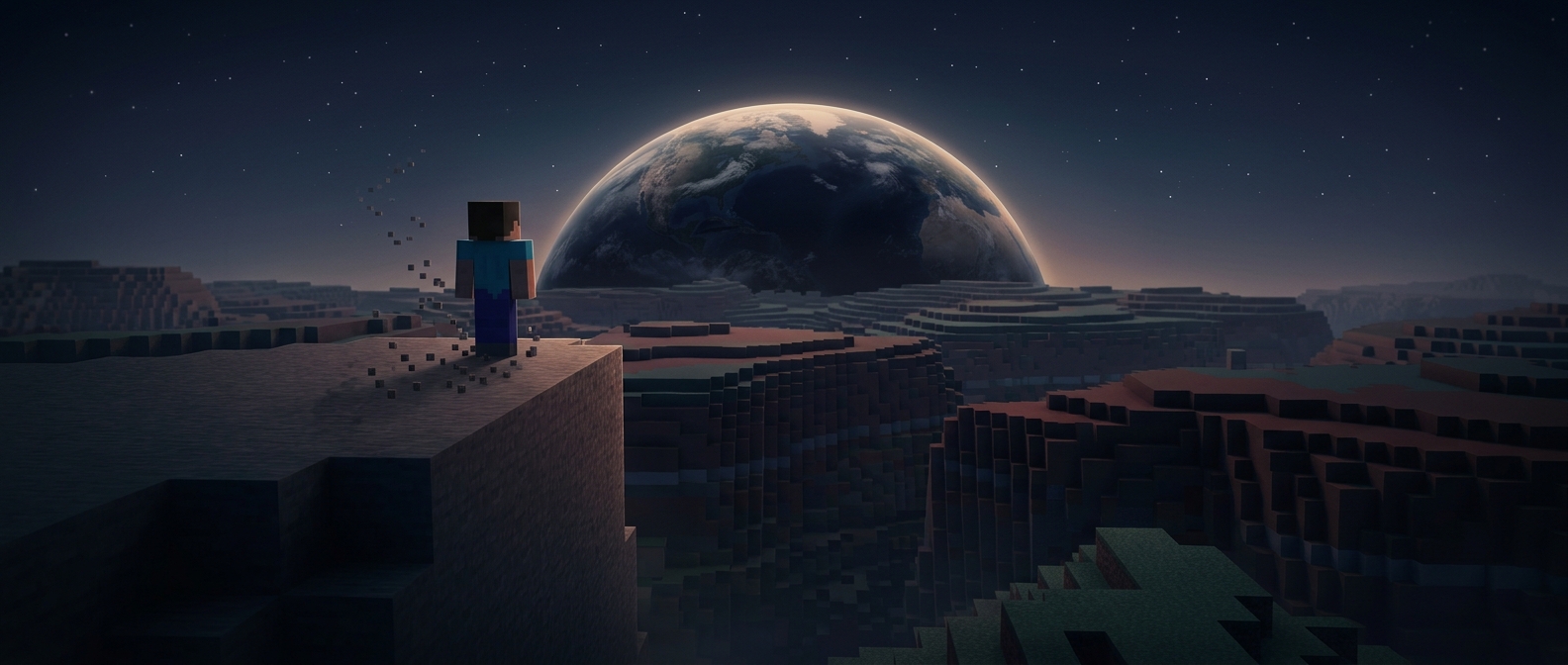
A Minecraft block is roughly a meter across, so the game’s immense coordinate range translates into an immense area in real-world units. The playable land is bounded, but the limit lies so far from the starting point that reaching it would require extraordinary travel across the game world.
That scale is a consequence of the game’s design: terrain is produced from coordinates rather than laid out by hand as one continuous map. A new region can be generated when needed, extending the journey without requiring a prebuilt map of every mountain and plain.
So the striking comparison with Earth is about the size of the space the game allows players to traverse—not a claim that every square kilometer is already rendered or filled with distinctive terrain. The next landscape can wait until someone gets close enough to see it.