A coda is a rhythm, not a roar
Sperm whales make clicks for more than one purpose. Many clicks are used in echolocation: sound pulses bounce off objects and return as echoes, helping a whale sense what is around it. Codas are different: they are short, patterned sequences of clicks whose timing makes them recognizable. The pauses and pace matter, much as rhythm can distinguish one familiar pattern from another.
How a local repertoire takes shape
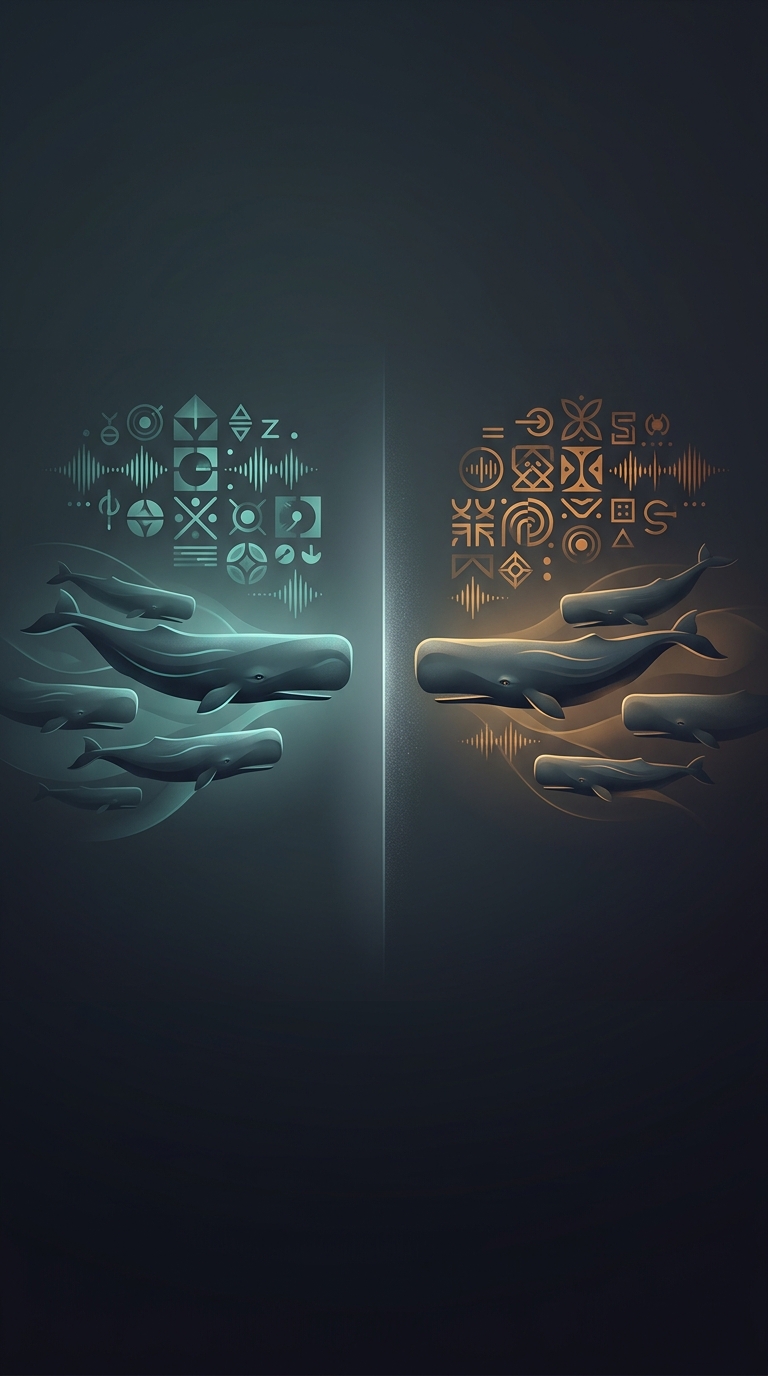
Young whales grow up hearing the calls of the whales around them. Calves learn their group’s coda patterns socially, so the repertoire is passed between generations rather than being only a fixed, inborn signal. Researchers have found that sperm whales belong to distinct social clans with characteristic coda patterns—something like regional dialects, though the comparison is not exact.
Those patterns can help whales recognize which clan others belong to. The sounds are therefore not merely messages sent one whale at a time; they are also part of a shared group identity, learned through life together.
Shared waters, different traditions
Clans do not need separate oceans to maintain different repertoires. Groups can occupy overlapping waters and still use characteristic patterns, just as neighboring human communities can share a place without speaking identically. The existence of different codas does not by itself prove that whales reject outsiders or judge them for “mispronouncing” a call. It shows that social learning can sustain recognizable traditions even among animals living side by side.
A whale’s clicks can thus carry two kinds of information at once: what is nearby, through echoes, and which familiar social world may be close enough to hear.