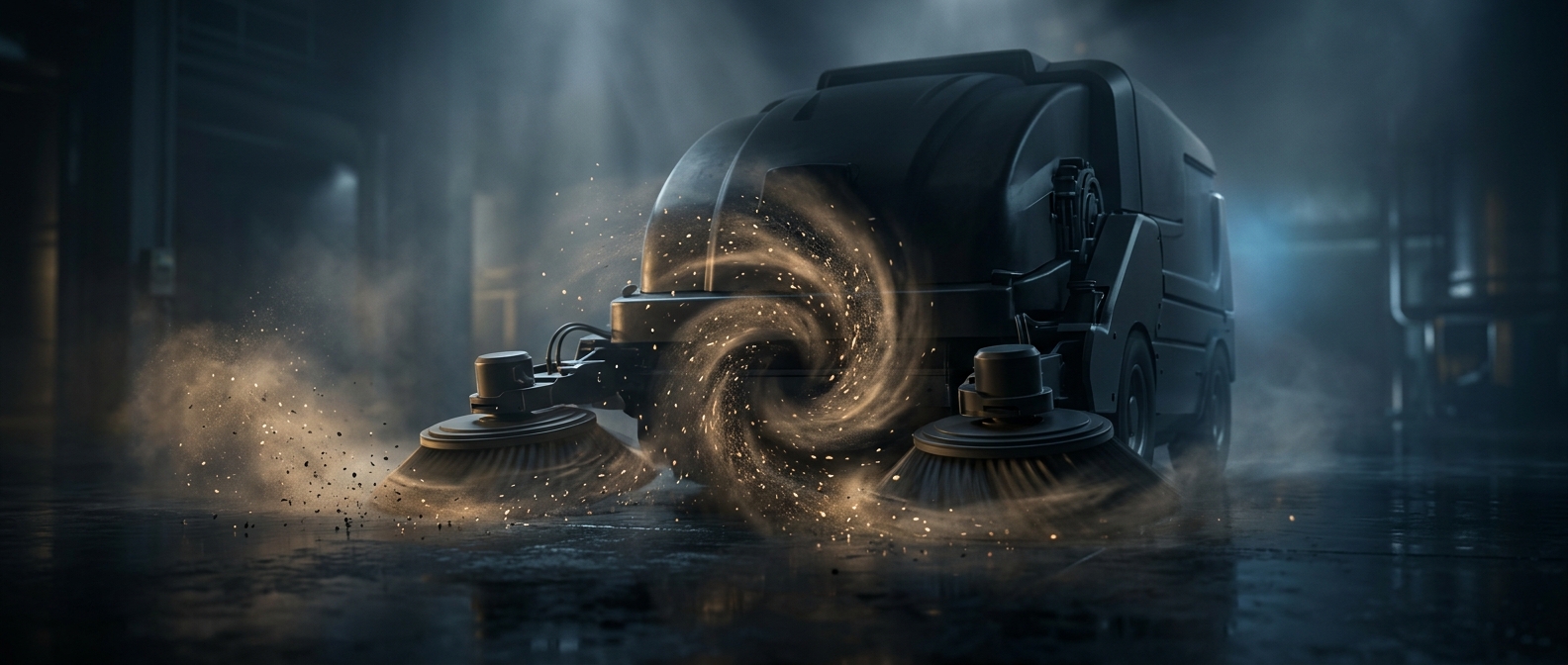
How a Sweeper’s Side Brooms Feed the Main Pickup
A street sweeper has to collect debris from a strip wider than the machine’s central intake. Its side brooms reach toward the curb, where grit, leaves, and litter tend to accumulate, then guide that material into the route of the main pickup system. The broom is not simply spinning in place: its bristles contact the pavement at an angle, so their sweeping motion nudges debris across the ground and inward.
The Angle Is the Important Part
The bristles flex as they meet the road. Their rotation and the direction in which they are set determine whether they push debris toward the center or scatter it away. Operators can lower or adjust many brooms to suit the surface and the material being swept; too little contact leaves debris behind, while too much can wear the bristles faster and make the broom work less effectively.
The side broom also works close to curbs and around obstacles, where a broad central pickup cannot reach as easily. It gathers material from that edge zone and places it where the machine can collect it. Depending on the sweeper, the next step may involve a mechanical conveyor or airflow that draws debris into a hopper—a storage bin carried by the vehicle.
A Tradeoff Between Reach and Control
A wider sweep can cover more pavement in one pass, but only if debris stays within the machine’s collection path. If a broom throws material outward, it can miss the intake or spread grit back onto the road. The inward-guiding action is therefore a small but essential part of the machine’s layout: it turns the side broom’s reach into material the sweeper can actually carry away.