Why the Utah teapot became a graphics test
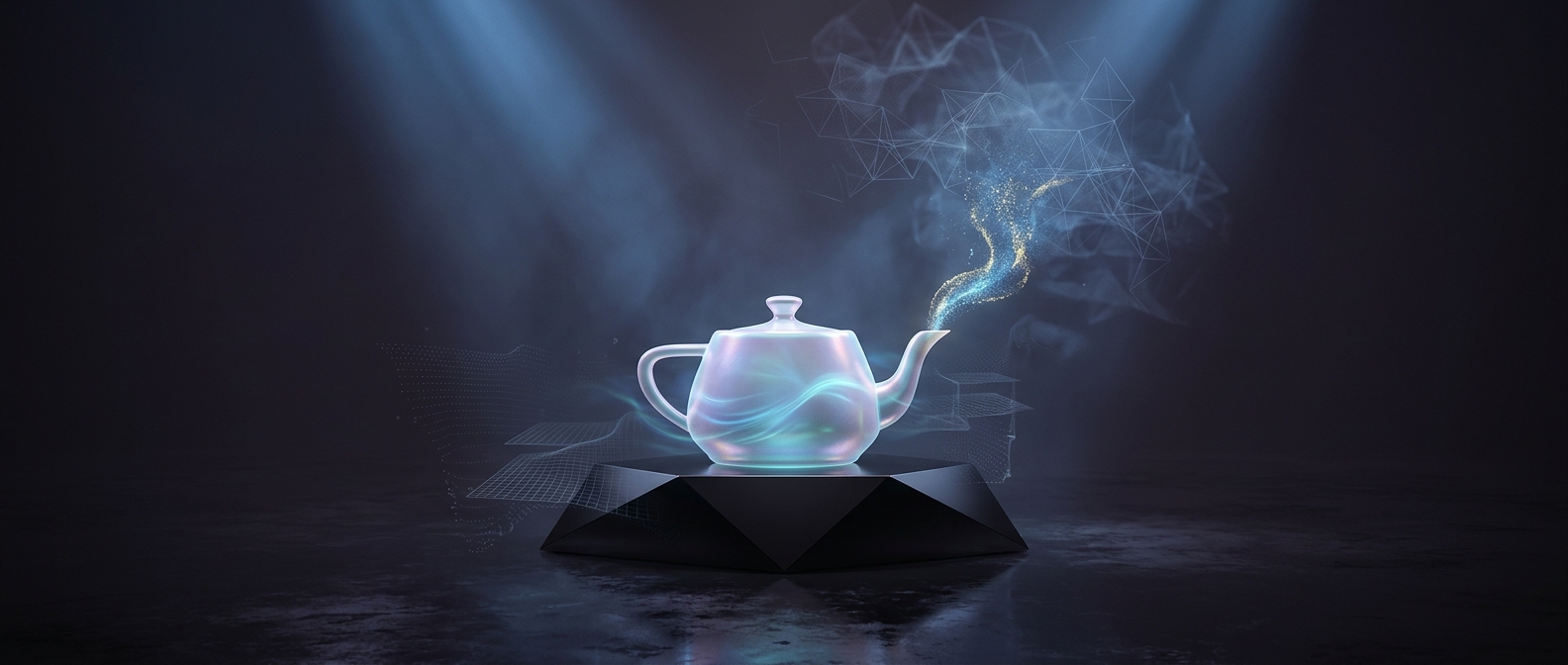
A teapot is a compact way to ask several hard questions of a renderer—the software that turns a 3D scene into an image. Its rounded body tests how smoothly a program handles curved surfaces. The handle and spout create openings and overlapping forms, while the lid adds another contour and a place for shadows to fall. Together, those parts reveal whether light, shading, and shape are being rendered convincingly.
From a model to a shared reference
In 1975, computer graphics researcher Martin Newell made a digital model of a teapot. At the time, researchers needed objects more revealing than the simple spheres and blocks often used in early demonstrations. Newell’s model was detailed enough to expose rendering problems, but familiar enough that viewers could tell when its shape looked wrong.
That combination made it useful beyond its original setting. As the model circulated among graphics researchers, it became a common reference object: a result could be compared against the same recognizable form rather than an unfamiliar test shape. The teapot’s enduring appeal is partly practical, too. Graphics toolkits such as GLUT have offered routines for drawing one, so developers can add a recognizable test object without building its geometry themselves.
A small object with many tests inside
The teapot is not a special ingredient in 3D graphics; it is a convenient diagnostic. A renderer that makes its curves look lumpy, its handle merge into the body, or its shadows fall incorrectly is revealing a problem that might also affect more complicated scenes. One familiar object can expose several different weaknesses at once—and make the result easy to recognize.