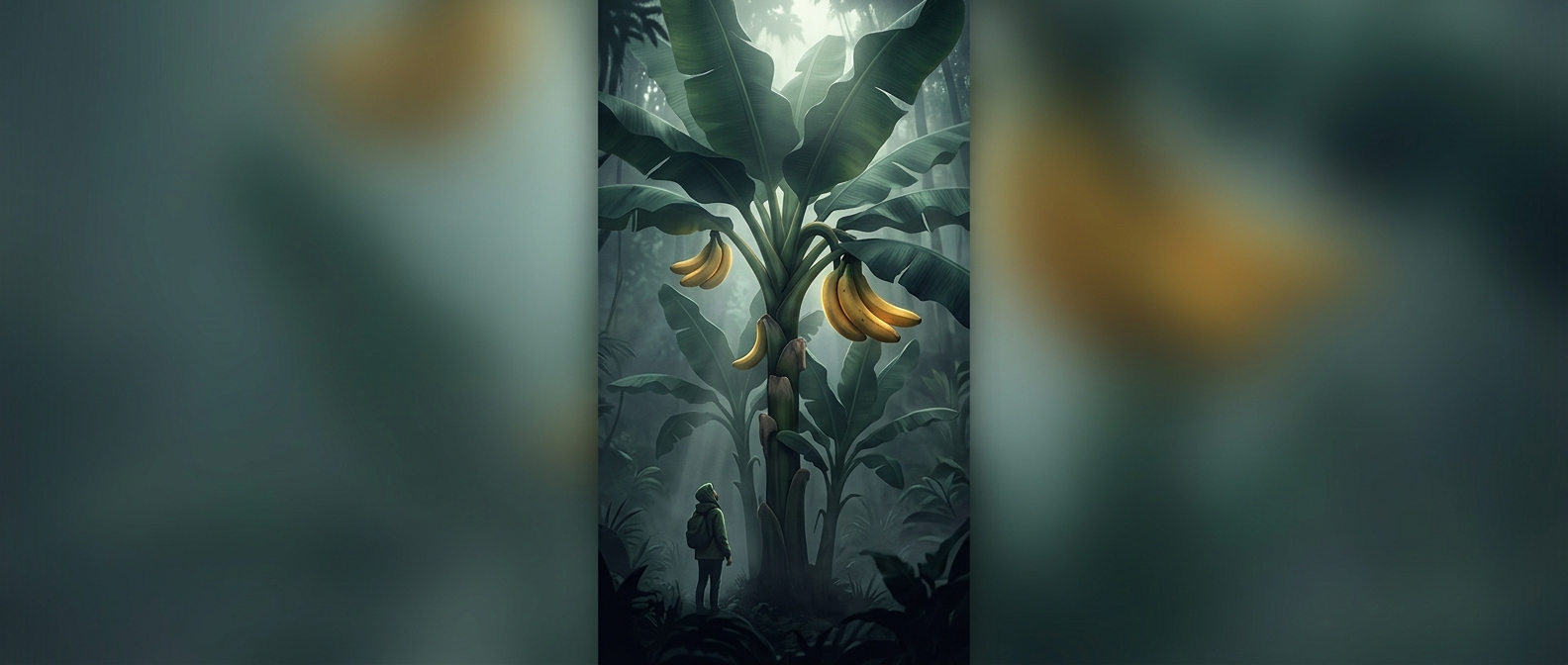
How a Banana Plant Builds Its “Trunk”
A banana plant has no woody trunk. What looks like one is a pseudostem: tightly wrapped leaf bases packed around the plant’s growing point. Each new leaf unfurls from the center, helping the pseudostem rise and support the plant’s broad canopy and heavy fruit cluster.
The leaves can make the plant seem tree-like, but its structure is closer to that of a large, fast-growing herb. Without wood to reinforce it, a banana plant relies on its layered leaf sheaths—and on a sheltered growing point—to reach several meters tall.
One Fruiting Shoot, Then a Successor
The plant’s underground stem, often called a rhizome or corm, produces new shoots called suckers. These grow beside the parent, drawing on the same underground base. As one shoot matures, it sends up a flower stalk through the pseudostem; the flowers develop into the familiar hanging bunch.
After that shoot has flowered and fruited, it does not produce another bunch. Its pseudostem gradually dies, while a younger sucker can take over. Growers often thin the extra suckers so the remaining shoots have room and resources to develop.
That turnover is why a banana patch can keep producing without each plant behaving like a long-lived tree. The visible stalk is temporary; the continuing life of the patch is carried forward underground by its next shoots.