From ocean life to airborne particles
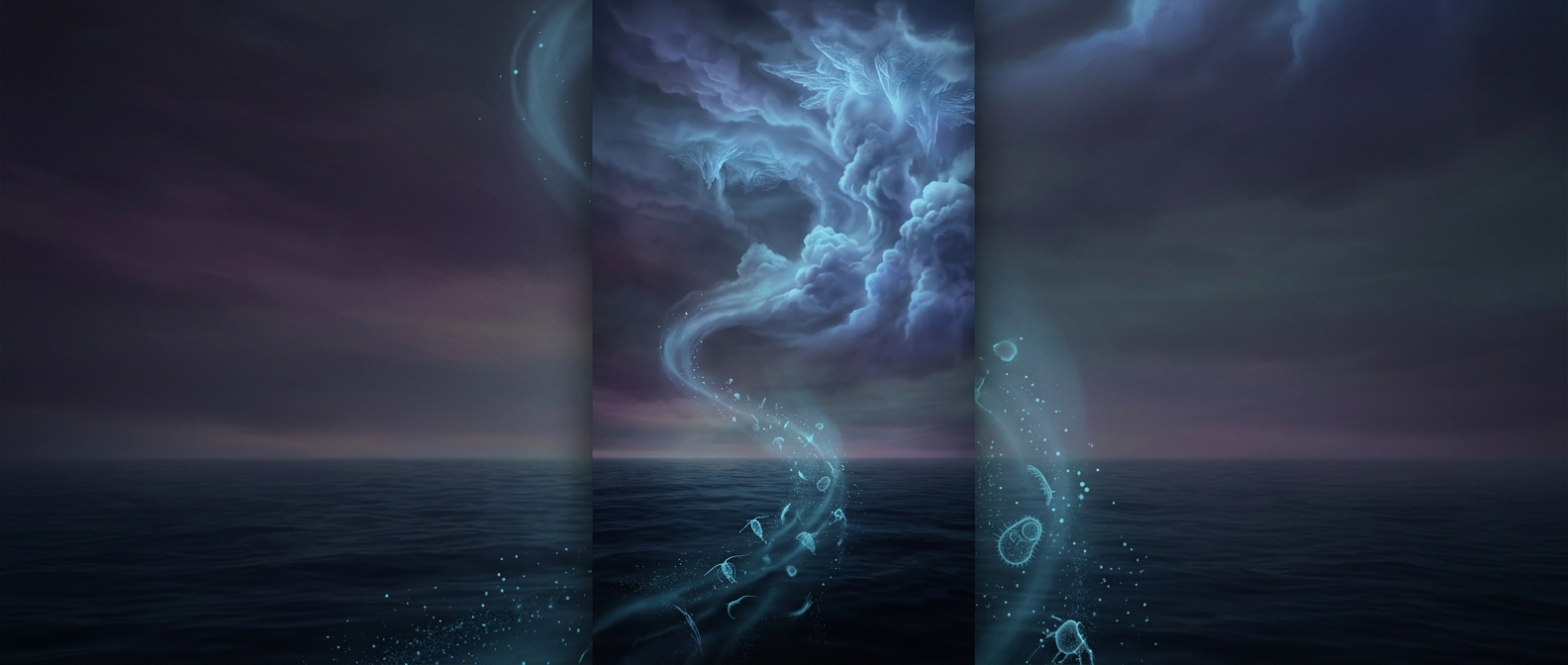
Clouds do not form from water vapor alone. In ordinary air, water molecules often need a microscopic surface to gather on; particles that serve this role are called cloud condensation nuclei. Over the ocean, some of those particles can begin with gases released by microbes living in seawater.
When the gases rise into the atmosphere, chemical reactions can turn them into tiny particles, or add material to particles already there. These particles may be carried upward and mixed with moist air. If conditions are right, water vapor condenses on them and grows into cloud droplets.
A small link in a much larger system
The pathway connects ocean biology to cloud formation, but it is not a direct switch. Microbes supply some of the chemical ingredients; sunlight, atmospheric chemistry, humidity, winds, and other particles all affect what happens next. A gas may be transformed or dispersed without producing particles that go on to seed a cloud.
That makes the connection important without making it all-powerful. The number and properties of airborne particles can influence how readily droplets form, while weather patterns and moisture determine whether clouds develop and persist. Ocean microbes are one contributor among many, not sky-makers acting alone.
The striking part is the chain of scale: life too small to see can release molecules that help create particles in the air, and those particles can become the starting surfaces for droplets visible as clouds.