A clockmaker’s solution to moving pictures
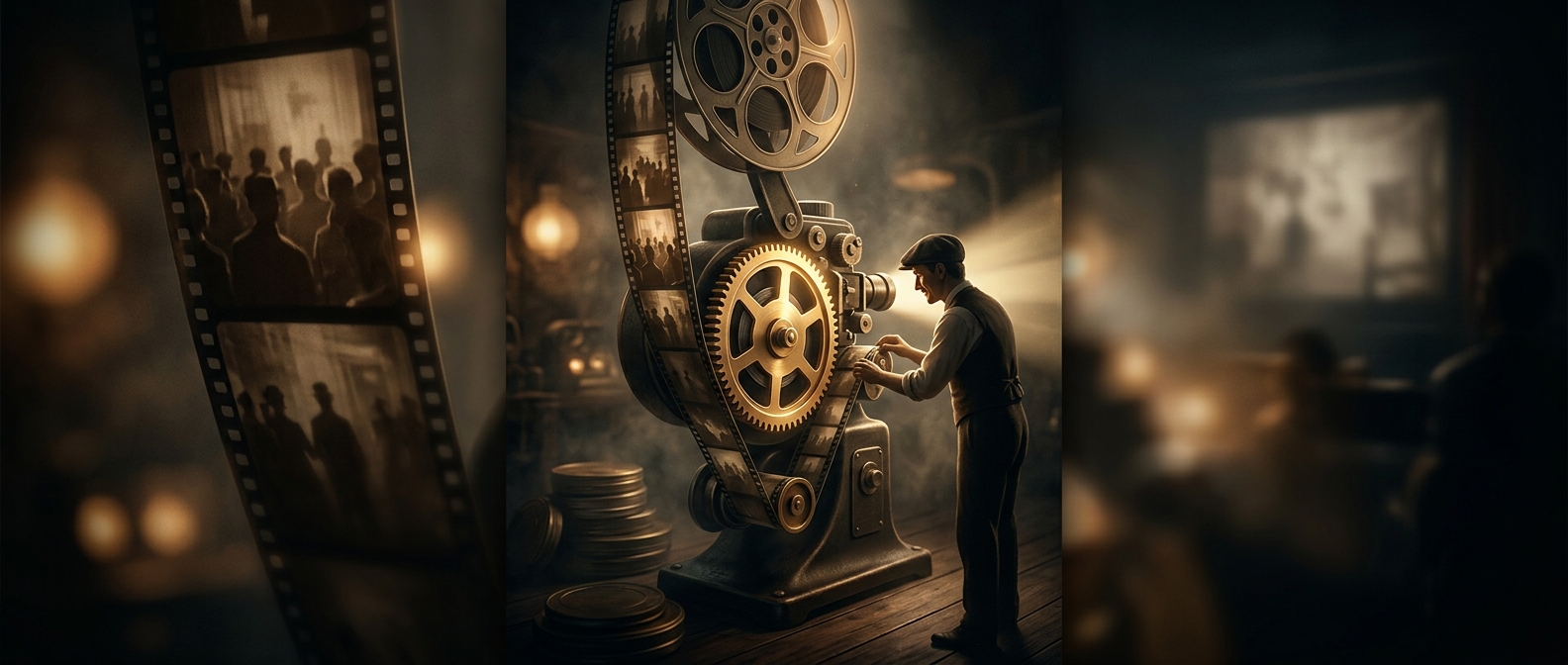
A projector has to do two seemingly incompatible things: move a strip of film forward, then hold it perfectly still while light shines through each frame. If the film slid continuously, the picture would smear. If it were yanked forward too abruptly, its thin, perforated edges could tear.
Oskar Messter adapted a mechanism used in clockmaking—the Maltese cross gear, also called a Geneva drive—to solve that timing problem. A rotating pin engages a slot in a cross-shaped wheel, turning it by a measured step before disengaging. In a projector, that step advances the film by one frame; the pause leaves the frame steady in the light path.
Why the pauses mattered
A shutter, timed to the gear, blocks the lamp while the film is moving. Once the film stops, the shutter opens and the audience sees a sharp image. The cycle repeats rapidly, creating the impression of continuous motion.
The gear’s controlled starts and stops also made the film’s movement more orderly than a simple, constant pull. That reduced the strain that could damage the strip, especially around the small perforations used to guide it. It did not make film indestructible, but it helped turn projection into a repeatable mechanical process rather than a risky tug-of-war with fragile material.
The result was a small piece of clockwork doing two jobs at once: setting the rhythm of the moving image and helping keep the film intact as it passed through the projector.