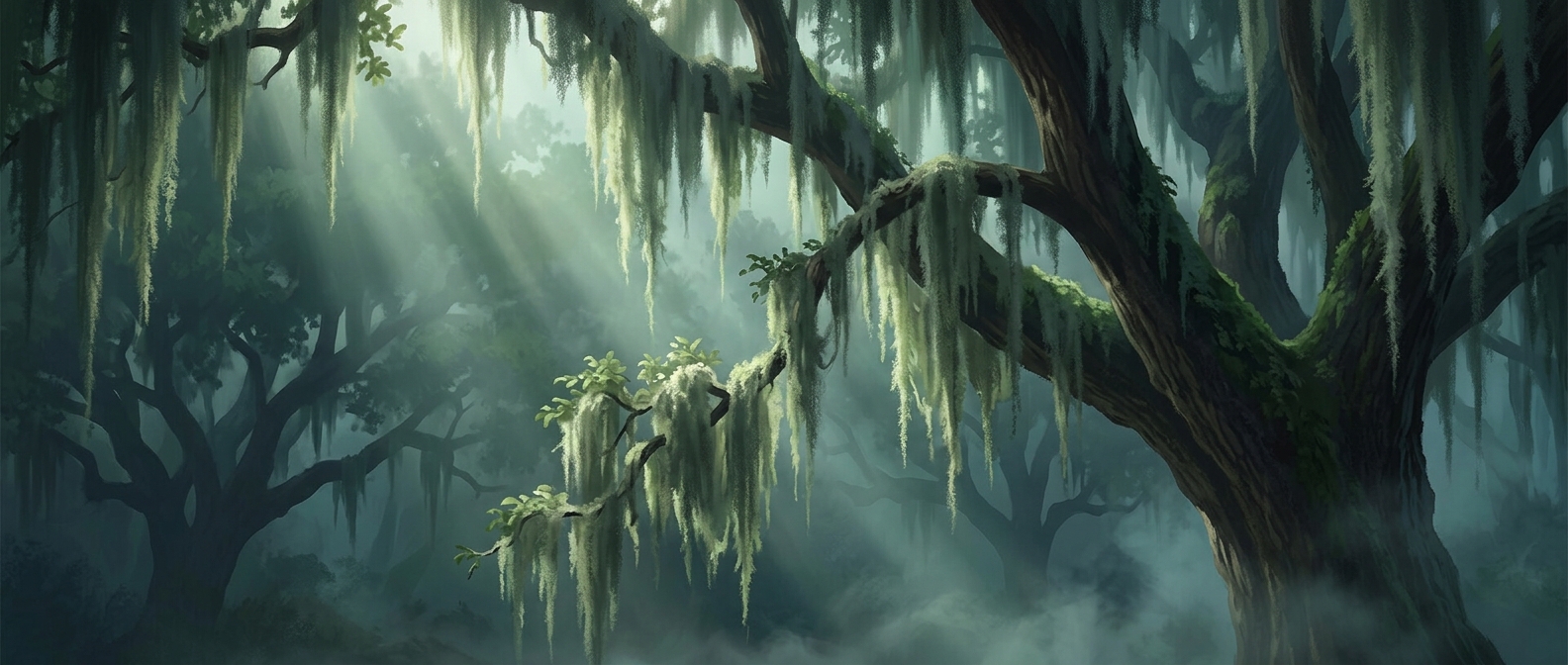
Spanish moss is an air plant, not a true moss
Spanish moss belongs to the bromeliad family, the same broad plant family as pineapples. It is an epiphyte: a plant that grows on another plant for support without taking food from it. Unlike a true moss, it is a flowering plant with stems, leaves, and seeds.
Its long, threadlike strands let it spread across branches and catch light while remaining exposed to the air. It makes its own sugars through photosynthesis, using sunlight and carbon dioxide, rather than drawing nourishment from the tree beneath it.
How its leaves collect what it needs
Spanish moss has no conventional roots for absorbing water from soil. Instead, its leaves are covered with tiny, specialized scales. When moisture reaches them, the scales help take it up; they can also capture dissolved minerals and particles carried in rain or dust. The plant’s unusually slender shape gives it plenty of leaf surface exposed to passing moisture and air.
That arrangement ties its growth to local conditions. In humid, rainy places, strands can stay hydrated and continue growing; in drier spells, they dry out and slow down until moisture returns. The tree supplies a sturdy place above the ground, but the plant’s own leaves do the work of gathering water and nutrients—an arrangement that lets Spanish moss drape through the canopy without being a parasite.