From arcade cabinet to tabletop challenge
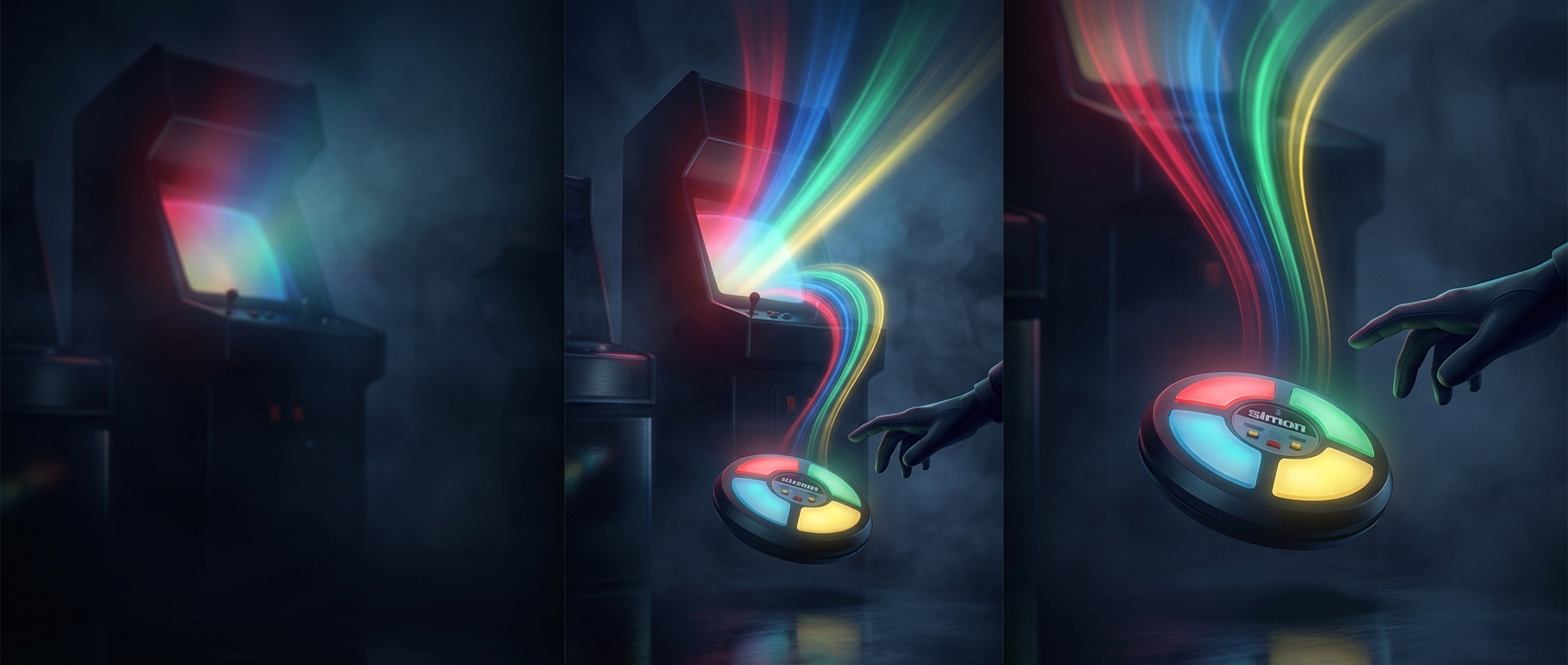
Atari’s Touch Me gave Simon its basic puzzle: watch a machine flash a sequence of buttons, then repeat it. The crucial change was not the rule but the form. Instead of an arcade cabinet, Simon put the challenge into a compact, round toy with four large, brightly colored buttons. Each button also had its own tone, so players could hear the pattern as well as see it.
That pairing made the game easy to understand without instructions. A light and sound mark one button; the player presses it. As the sequence lengthens, the player must remember the order, not merely which buttons appeared. The machine supplies the pattern, while the player supplies the memory.
A simple rule that scales
Simon’s design turns a tiny set of choices into an escalating test. With four possible buttons, a short sequence is manageable; every added step makes it harder to keep the order straight. A wrong press ends the attempt, giving the game a clear consequence and making each successful round feel like progress.
The bright colors, distinct tones, and physical buttons do practical work: they make each choice easy to distinguish, even as the sequence grows. The result was an arcade idea that could travel from a public machine to a living-room table—and a game whose entire challenge fits in the space between hearing a pattern and deciding whether you can repeat it.