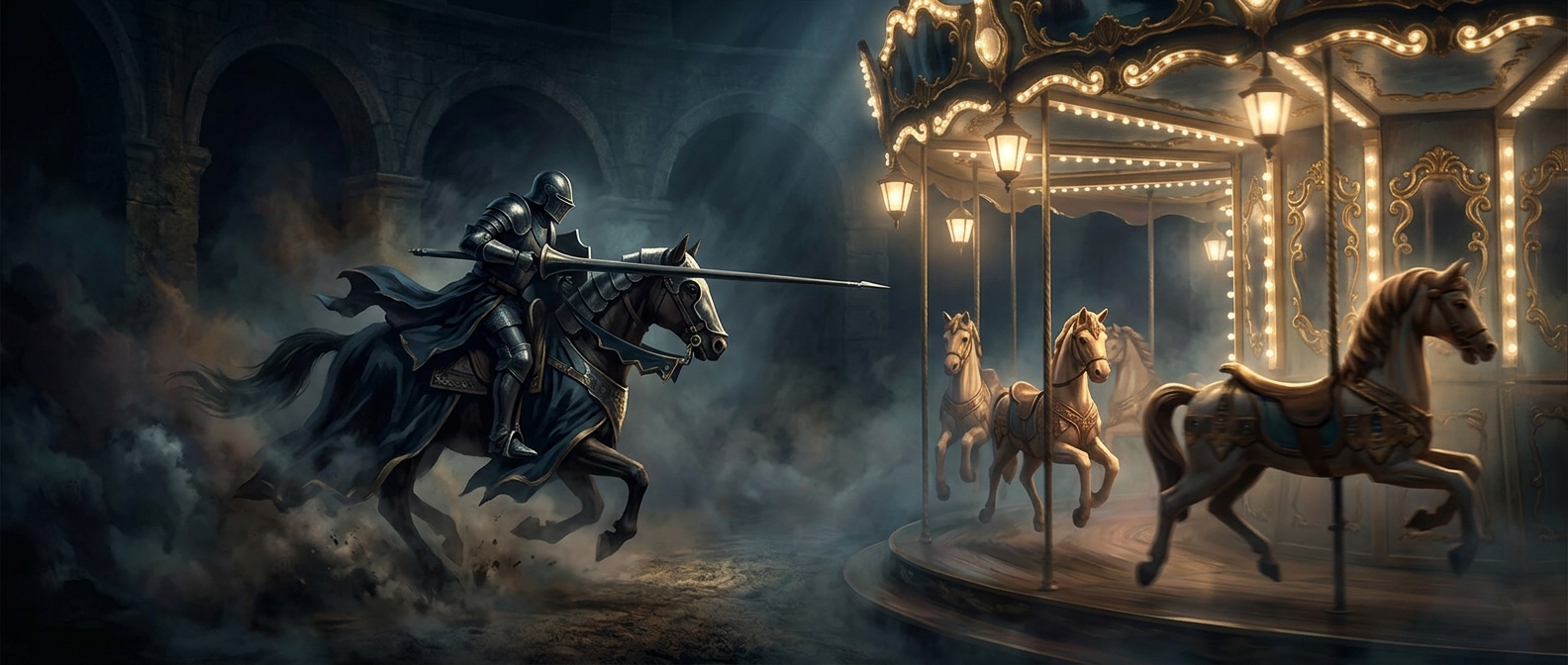
A moving target for mounted riders
For a knight, controlling a horse while aiming a long lance was a demanding combination of balance, timing, and precision. Riding a circular course made the exercise repeatable: each pass brought the rider back toward a target, such as a ring hung from a frame. Catching the ring on the lance’s tip rewarded a steady line and a well-timed reach—not simply a forceful charge.
The circle also made the exercise useful for groups. Riders could follow a set path and take turns approaching targets, practicing coordinated movement without staging a full battle. Such displays could serve as training, competition, or public spectacle.
From equestrian game to amusement ride
The modern carousel is not a battlefield machine that simply survived unchanged. Its connection is in the circular riding display: people mounted on horses moving around a central point. Over time, that idea was translated into a powered amusement ride, where mechanical motion replaced the trained horse and rider.
That shift changed the purpose but preserved a recognizable image. A carousel turns an activity once associated with horsemanship and martial skill into a shared leisure experience. Its painted horses and circling motion are reminders that the ride’s familiar form grew out of a world where staying mounted and striking a small target could be practical skills.