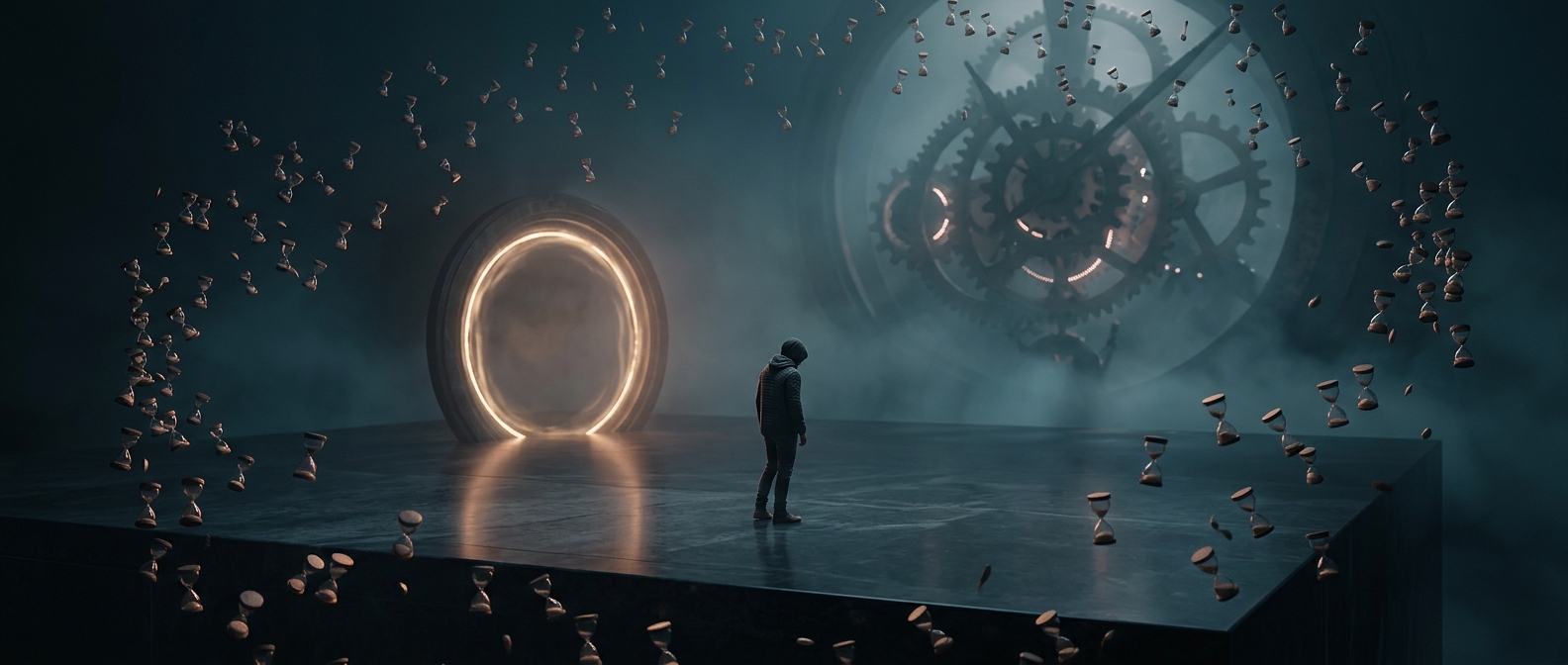
How researchers timed a dream
A dream has no visible clock, so researchers use lucid dreamers—people who know they are dreaming and can sometimes choose their actions—to mark time from within. Before sleep, participants agree on a simple signal, such as moving their eyes in a set pattern. In a sleep lab, those eye movements can be recorded while the rest of the body remains still.
A typical test asks the dreamer to signal, perform a task in the dream, then signal again. Researchers compare the interval between those signals with the time the same task takes when the person is awake. The comparison gives them a rare way to estimate how long a dream action lasts without relying only on a later memory of it.
Dream time is not always a perfect match
For familiar actions such as counting or walking, measured dream intervals have often been broadly similar to waking intervals. But the match is not exact: some dream tasks take longer, and movements can be harder to carry out in a dream than their waking equivalents. The result is not that every dream unfolds at precisely the speed of ordinary life, but that dreams are not generally compressed into a rapid montage simply because they feel strange or vivid.
Dreams can also seem to skip ahead or change scenes abruptly. That makes the remembered story a poor stopwatch: a dreamer may recall a long sequence without remembering every transition, or remember only the most striking moments after waking. Timing a specific action is more informative than estimating the duration of an entire dream from its plot.
What the clock tells us—and what it cannot
These experiments measure short, intentional episodes in lucid dreams, not every kind of dream or the full duration of a night's dreaming. Still, they challenge the popular idea that a complicated dream must have happened in an instant. If a dreamer counts through a planned interval or walks a route, the brain can spend a comparable stretch of sleep representing that activity—long enough for the imagined action to have its own pace.