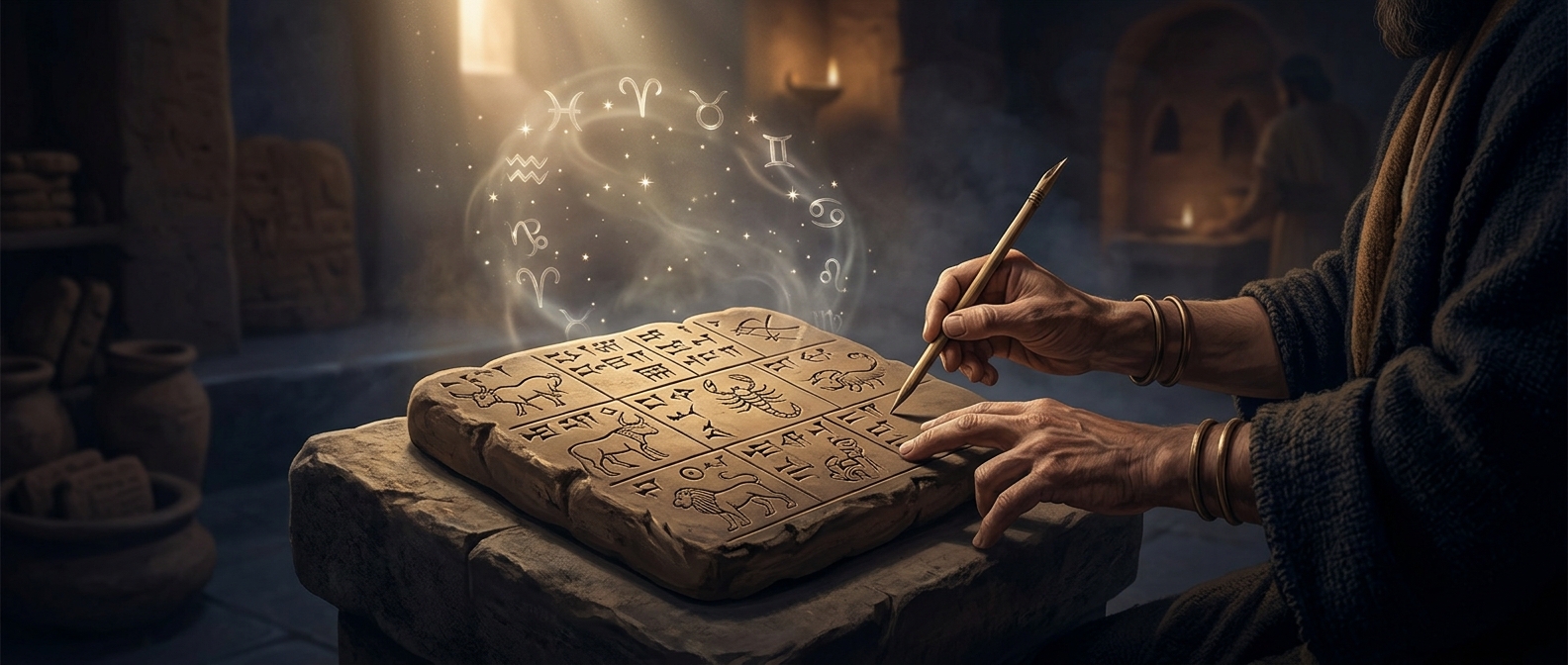
A birth chart pressed into clay
Around 410 BC, Babylonian scribes recorded personal horoscopes by pressing cuneiform—wedge-shaped marks—into damp clay. The tablet was more than a list of zodiac signs: it preserved a reading of the sky at a particular person’s birth and the predictions attached to it. Once the clay dried, the reading could outlast the person who commissioned it—and, unlike a spoken forecast, could be consulted again.
How the prediction was made
Babylonian astrology grew from a tradition of treating celestial events as omens. A personal horoscope applied that way of interpreting the heavens to an individual. The astrologer recorded where the Moon and planets stood in the zodiac, the band of constellations through which they appear to move, then linked those positions to possible outcomes.
That is different from the familiar modern newspaper horoscope, which gives the same short forecast to everyone born under one sign. These early tablets were tied to a specific birth, and their forecasts could be stark: some warned that a child faced a violent death. They expressed a belief about what the sky portended, not a measured prediction in the modern scientific sense.
From sky observation to a personal fate
The tablet made an abstract interpretation concrete. A sequence of celestial positions became a record attached to one person, while the clay preserved both the observations and the feared consequence. The striking shift was from reading the sky for signs about the world to using it to forecast an individual life. That personal focus is the feature that makes these Babylonian records recognizable as horoscopes today.