Why Cut a Road Into the Cliff?
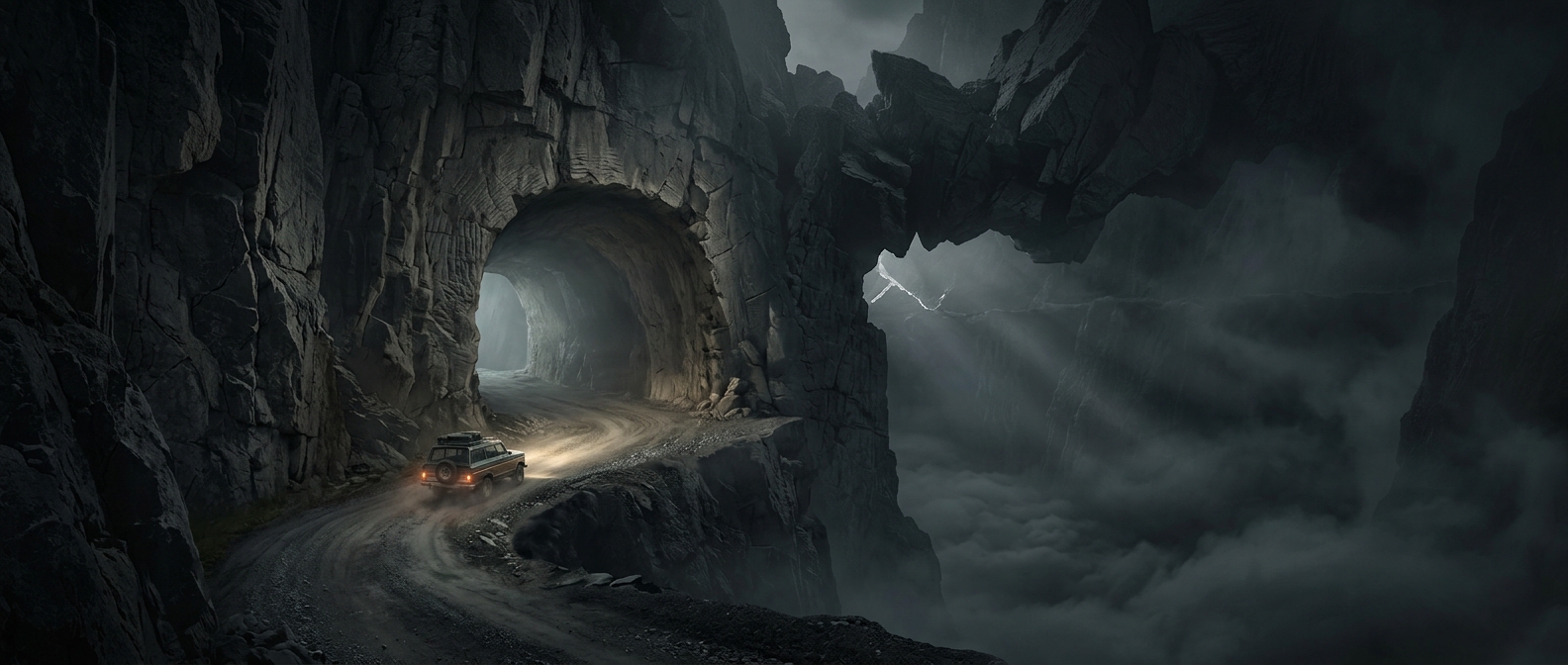
A road that wraps around a mountain needs room to curve. Where the slope is too steep or the terrain leaves little space, cutting into the rock can create a more direct route—but it trades distance for a difficult excavation job. The road has to be carved from the cliff itself, with solid rock forming its roof and outer wall.
The Work Moves From the Inside Out
With hand tools, workers could remove rock only a little at a time. Each newly opened stretch created more room to continue, while the spoil—the broken rock produced by digging—had to be cleared before the next section could be worked. Openings along the route served as outlets for that rubble and brought daylight into the passage. They also exposed just how little separates the roadway from the drop beyond it.
The openings are not merely decorative windows. They make the route feel less enclosed, but they are also evidence of the practical problem the builders faced: every chunk of rock removed had to go somewhere. A winding road would have avoided much of this cutting, but it would have taken a different path across the mountain.
A Shortcut With the Mountain Still in the Way
Carving through the cliff reduces the need to circle the slope, yet it leaves the road constrained by the rock around it. Its width and shape follow the space workers could create, rather than the generous curves of a modern highway. The result is a route whose windows reveal both the view and the method of construction: the mountain was not bypassed, but laboriously opened a piece at a time.