A monastery with an army
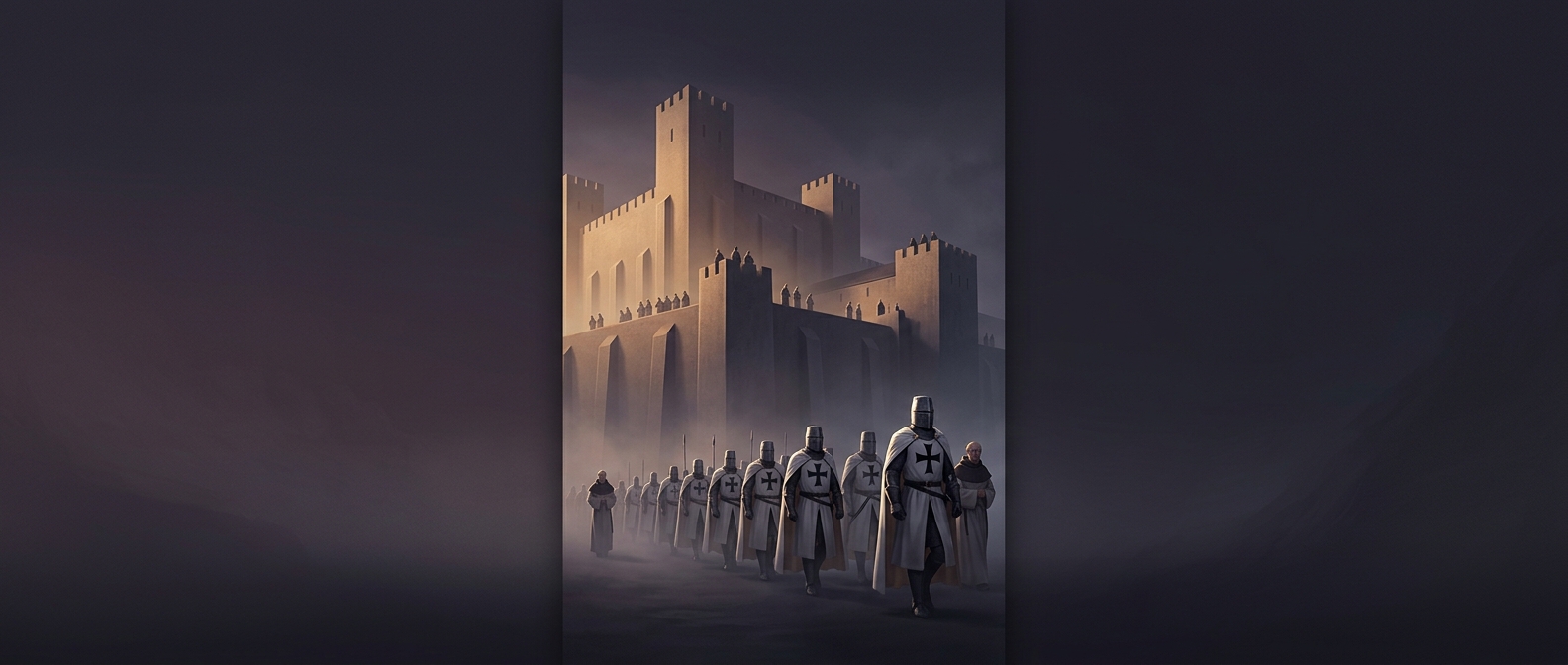
The Teutonic Knights began as a religious brotherhood that cared for Christian pilgrims and fought in the Crusades. In the late 12th century, they established themselves on the Baltic frontier, where Christian rulers and church authorities backed campaigns against peoples who had not adopted Christianity. The Order’s members took religious vows, but they also fought, governed, and controlled land.
In the 13th century, the Knights conquered much of the territory of the Prussian peoples, who were distinct from the later German state of Prussia. The Order built castles across the region, making each a military stronghold and an administrative center. From this network, it governed territory as a state: its leaders collected revenue, directed campaigns, and managed settlements.
Conquest became government
The Order’s religious mission and political interests reinforced one another. Conquest was presented as a way to spread Christianity; control of land and its resources, in turn, helped sustain the Order’s forces and administration. German-speaking settlers arrived in conquered areas, and towns grew under the Knights’ authority. The result was not simply an army occupying the coast, but a durable government built around its military and monastic institutions.
The Order’s rule was never uncontested. Its wars brought it into conflict with neighboring powers, especially the Polish-Lithuanian union. Defeat at the Battle of Grunwald in 1410 weakened its position, though its state survived for more than a century afterward.
When the religious state ended
In 1525, the Order’s Grand Master, Albert of Brandenburg, converted to Lutheranism and turned the Order’s Prussian territory into the secular Duchy of Prussia, under Polish overlordship. The change shows how closely the Knights’ religious authority had been tied to their political rule: when that religious framework shifted, the state itself could be transformed. Castles built to secure a crusading frontier had become the foundations of a territorial government—and, eventually, a duchy.