The pavement marks two optical viewpoints
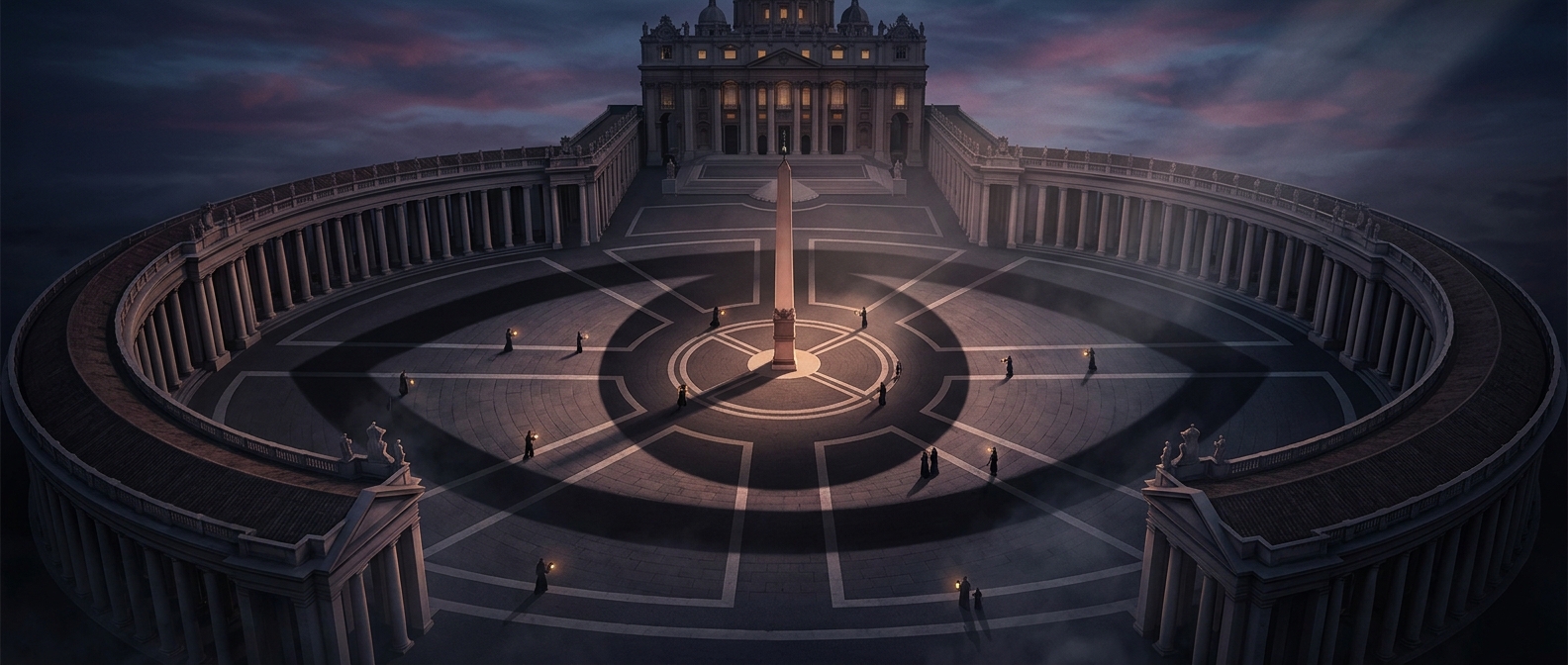
In St. Peter’s Square in Vatican City, two marble discs mark spots where the colonnade seems to collapse into a single line of columns. The structure is four rows deep. From a disc, the columns in the outer three rows line up almost exactly behind the nearest row, so those farther rows are hidden from view.
Nothing moves or vanishes: it is a matter of perspective. Each row stands at a slightly different distance from the viewer, but from the marked point the columns overlap in the sightline. Step to one side, and the alignment breaks; the separate rows become visible again.
Bernini made the geometry part of the experience
The colonnade was designed by Gian Lorenzo Bernini in the 17th century as a monumental frame for the square in front of St. Peter’s Basilica. Its repeated columns give the broad space a strong visual rhythm. The pavement markers turn that architecture into something visitors can test for themselves: walk to the indicated spot, and a layered structure briefly reads as one row.
The effect depends on a precise relationship among the columns, the viewer’s position, and the direction of sight. The discs are not merely decorative markers; they identify the viewpoints from which the architecture’s depth is hardest to see. Move just a few steps, and the square’s four-deep construction reappears. It is a small demonstration of how a public space can guide not only where people stand, but what they see.