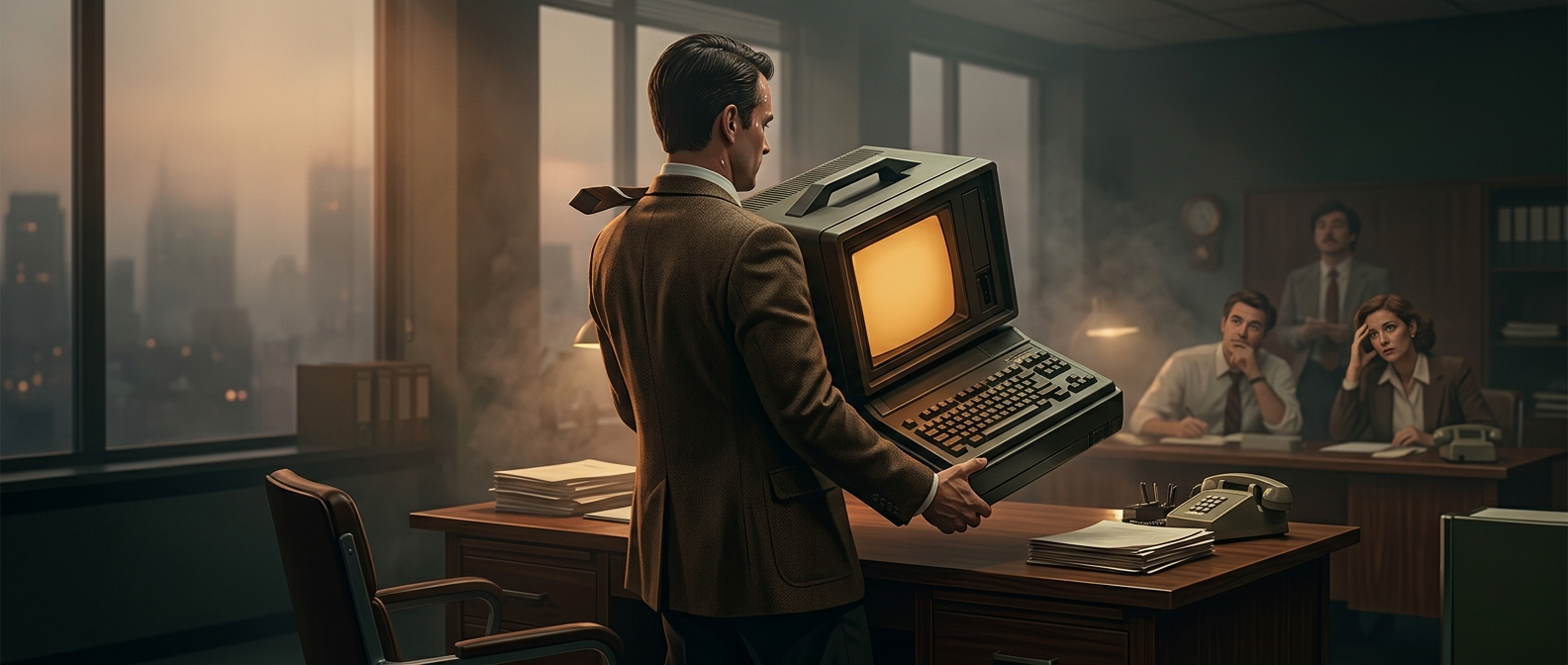
Portability Meant Carrying the Computer, Not Using It Anywhere
The Osborne 1 belonged to an early era of personal computing, when “portable” described a machine that could be moved between places—not one designed to run untethered. It had no built-in battery, so using it meant finding a power outlet and setting the computer down. Its weight made the trip itself a commitment, but it could travel with its owner rather than remain permanently installed on a desk.
That distinction mattered to people who needed their work in more than one location. A small business owner or traveling professional could bring the same computer to an office, a client meeting, or home, instead of relying on separate machines or recreating files by hand.
The Case Was Part of the Engineering
The Osborne 1 packed a complete working setup into one case: the screen, keyboard, computer electronics, and two floppy-disk drives. Floppy disks were removable storage, letting users load programs and save files without a hard drive. The integrated arrangement avoided the need to carry a separate monitor, but it also meant the screen and keyboard had to fit within a single, heavy unit.
Its tiny display imposed another tradeoff. The screen showed only a narrow slice of text at a time, so users had to work within a cramped view. The design favored having a functioning computer in one package over the comfort and spacious display of a desktop system.
Software Made the Trip Worthwhile
The machine ran CP/M, an operating system used by many early microcomputers. It also came with useful programs, including word-processing and spreadsheet software. Bundling applications reduced the effort of turning the computer on and getting to work: buyers did not have to assemble a useful software collection before the machine could serve everyday tasks.
The Osborne 1’s legacy is therefore less about effortless mobility than a change in what “taking your computer with you” could mean. A machine could be portable enough to move between work settings, even if using it still required a table, an outlet, and patience with a very small screen.