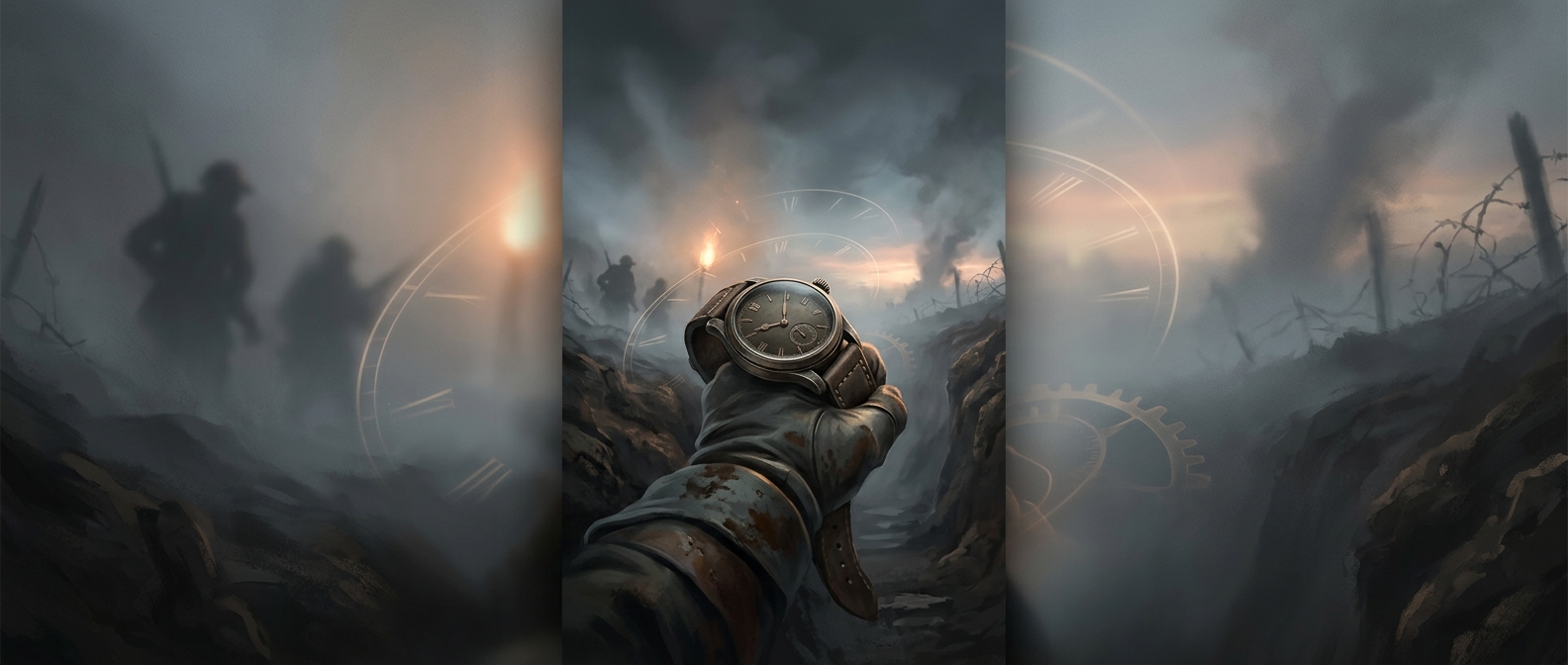
A watch became part of a soldier’s kit
The wristwatch was not invented in the trenches. Before the First World War, wrist-worn watches already existed, though pocket watches remained a familiar choice, especially for men. Combat changed the practical calculation: reaching into a pocket could take time, and a soldier might need both hands free while moving, handling equipment, or taking cover.
Timing mattered beyond convenience
Trench fighting depended on coordination among people who could not always see one another. Units might need to move at an agreed time, while artillery crews and infantry had to coordinate actions across a battlefield. A watch fixed on the wrist could be checked with a glance, helping a soldier keep track of a schedule without first retrieving and opening a pocket watch.
That did not make every battlefield action run precisely to plan. It did make timekeeping more accessible in situations where fumbling for a watch was awkward or risky. The value was not simply knowing the hour; it was being able to consult it while staying ready to act.
A pocket-watch design adapted for the wrist
Many early wristwatches drew on the technology of pocket watches, fitted into cases that could be worn on a strap. Some had protective metal covers over the glass, useful in rough conditions. The change was modest in engineering terms, but significant in use: a timepiece moved from a pocket to a place where it could be read quickly.
Wartime demand helped make that format familiar to a much wider public. After the war, wearing a watch on the wrist no longer seemed like an unusual convenience; it had proved its worth as practical equipment.