How a Miss Becomes Information
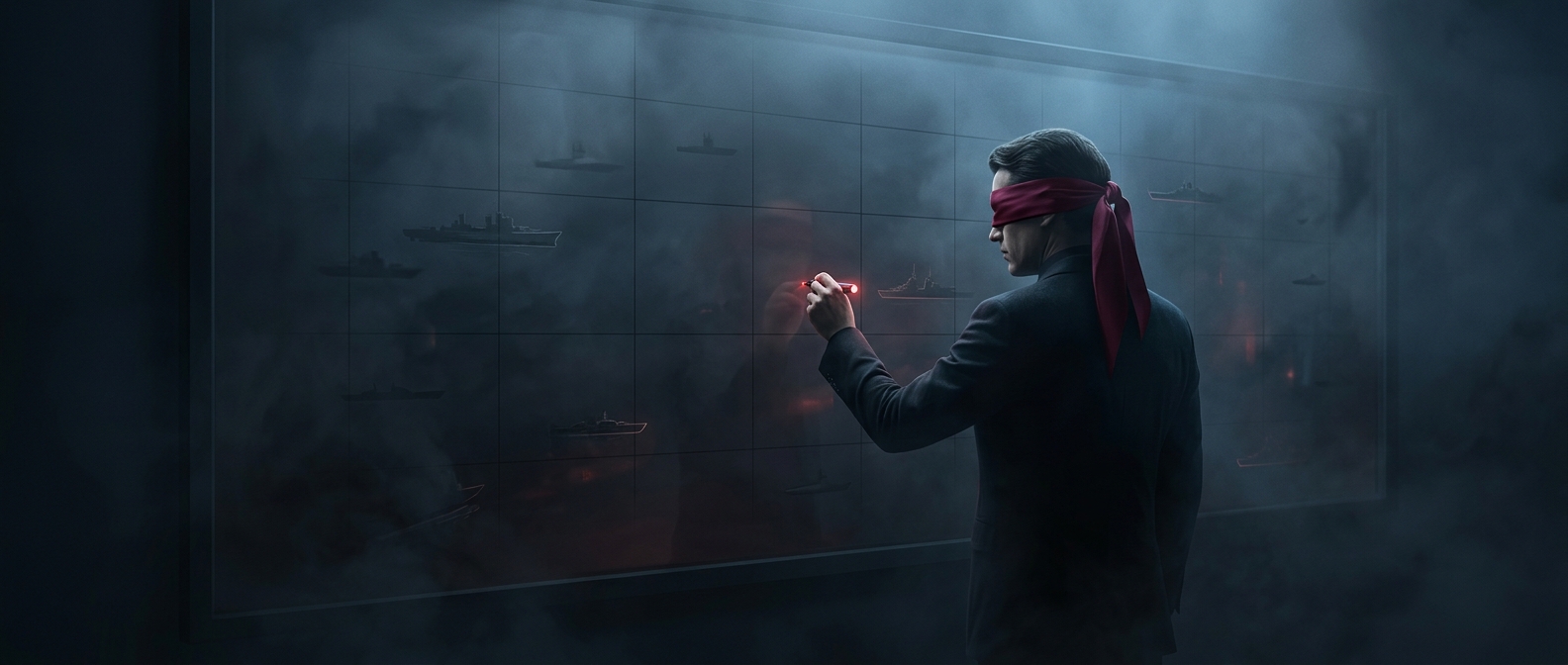
In Battleship, each player sees their own fleet but not the opponent’s. A turn begins with a coordinate call—such as B-6—and the opponent reports whether it struck a ship. That simple reply is the game’s only window into a hidden board.
A miss rules out one square. A hit narrows the possibilities: because ships occupy several connected squares, nearby coordinates become more promising than distant ones. Players often switch from searching widely to testing adjacent squares, trying to discover which way a ship runs and where it ends. The board gradually changes from a field of guesses into a map of deductions.
The Opponent Is Part of the Puzzle
The clues are useful, but incomplete. A hit does not identify the ship, and a miss says nothing about the untested squares around it. Players must decide whether to probe near a known hit or keep searching elsewhere—and anticipate where an opponent might have placed ships.
That uncertainty makes fleet placement strategic, too. A predictable arrangement can be found quickly once shots begin connecting; a less obvious arrangement may take longer to decode. Neither player can see the whole contest at once. The game turns a handful of public answers into a contest of inference, where every call can both damage a fleet and reveal how its hidden layout might fit together.