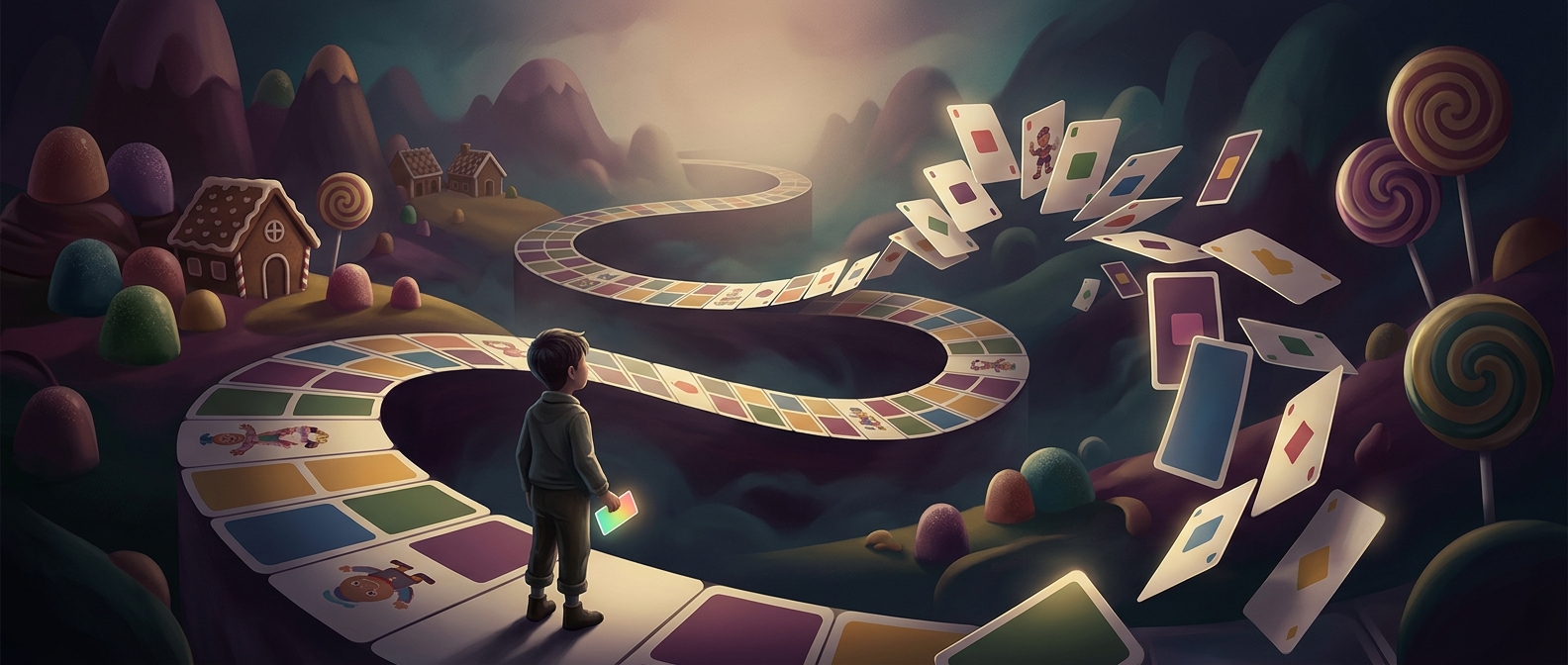
A race with almost no decisions
In Candy Land, a turn is mostly a card draw: the card shows a color, and a player moves to the next space of that color. Some cards send a pawn to a named spot farther along the path. Because players do not choose where to go or which route to take, there is little room to improve a position through strategy.
That makes the deck—not tactical skill—the engine of the game. After it is shuffled, the order of its cards shapes how quickly each pawn advances and which player reaches the finish first. The outcome is not literally fixed before play begins: the cards are revealed one by one, and their order matters. But players have little control over what that order does to them.
The design is the point
This simplicity makes the game playable by children who may not yet read fluently, count reliably, or understand strategic tradeoffs. Matching a card’s color to a space is enough to take a turn. Adults can participate without needing to teach a complicated system, while young players still get the suspense of waiting to see what the next card brings.
The tradeoff is that a player can make every turn correctly and still fall behind—or win without having made a clever choice. Candy Land turns a board game into a shared exercise in anticipation: the meaningful event is not deciding what to do, but discovering what the deck has dealt.