The view that interrupted Mondrian’s sense of order
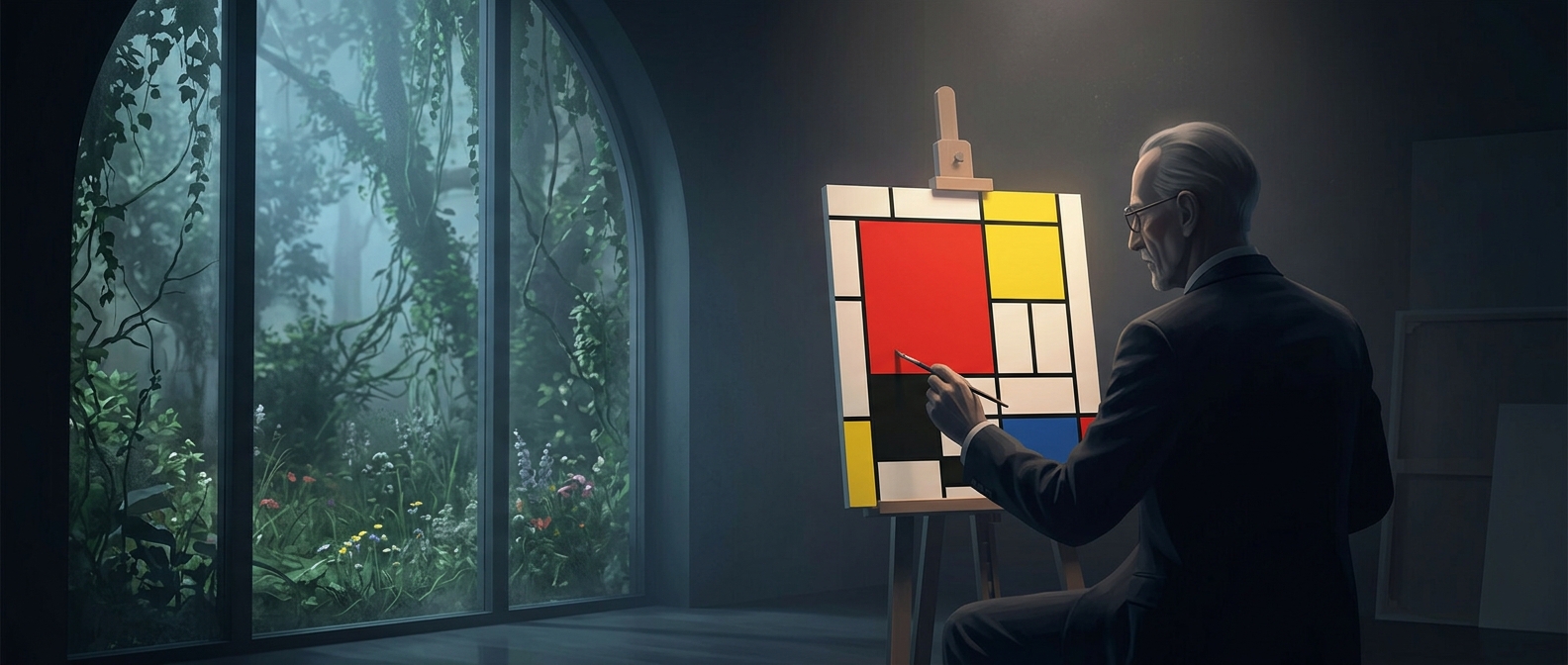
The story of Piet Mondrian changing seats at a restaurant is striking because it turns an artistic principle into a small, physical choice: a park’s irregular forms were distracting enough that he preferred another view. It suggests how persistently he looked for order—not only on canvas, but in the shapes around him.
From landscapes to an underlying structure
Mondrian did not begin by painting only grids and primary colors. He first made recognizable subjects, including trees and other landscapes. Over time, he simplified those subjects, reducing branches, trunks, and horizons toward patterns of vertical and horizontal lines. The shift was not simply from “nature” to something unrelated to it. It was an effort to make visible what he thought lay beneath appearances: a more balanced structure.
A tree, with its branching limbs and uneven silhouette, resists the clean geometry of a straight line. In his mature paintings, Mondrian replaced that visual complexity with carefully arranged rectangles, lines, and color fields. The goal was not to copy what the eye sees, but to construct a balance that feels more fundamental than any single scene.
A personal habit, not a universal rule
The restaurant anecdote makes that artistic pursuit sound almost like an intolerance of nature. But one seat choice cannot establish that Mondrian disliked trees or wanted to escape the natural world altogether. It is better understood as a vivid glimpse of the tension his work addressed: nature offers endless variation, while his paintings seek a spare, controlled order.
That tension is what makes the story memorable. Even away from the studio, an ordinary view could become a problem of composition—and changing seats could be the simplest way to resolve it.