How a dinosaur could acquire the wrong head
A fossil is not necessarily a complete animal preserved in place. After death, a body may be scavenged, carried by water, or broken apart as soft tissues decay. A skull—especially one with thin, fragile bones—can come loose and end up some distance from the rest of the skeleton. Sediment may then bury the pieces at different times or in different places.
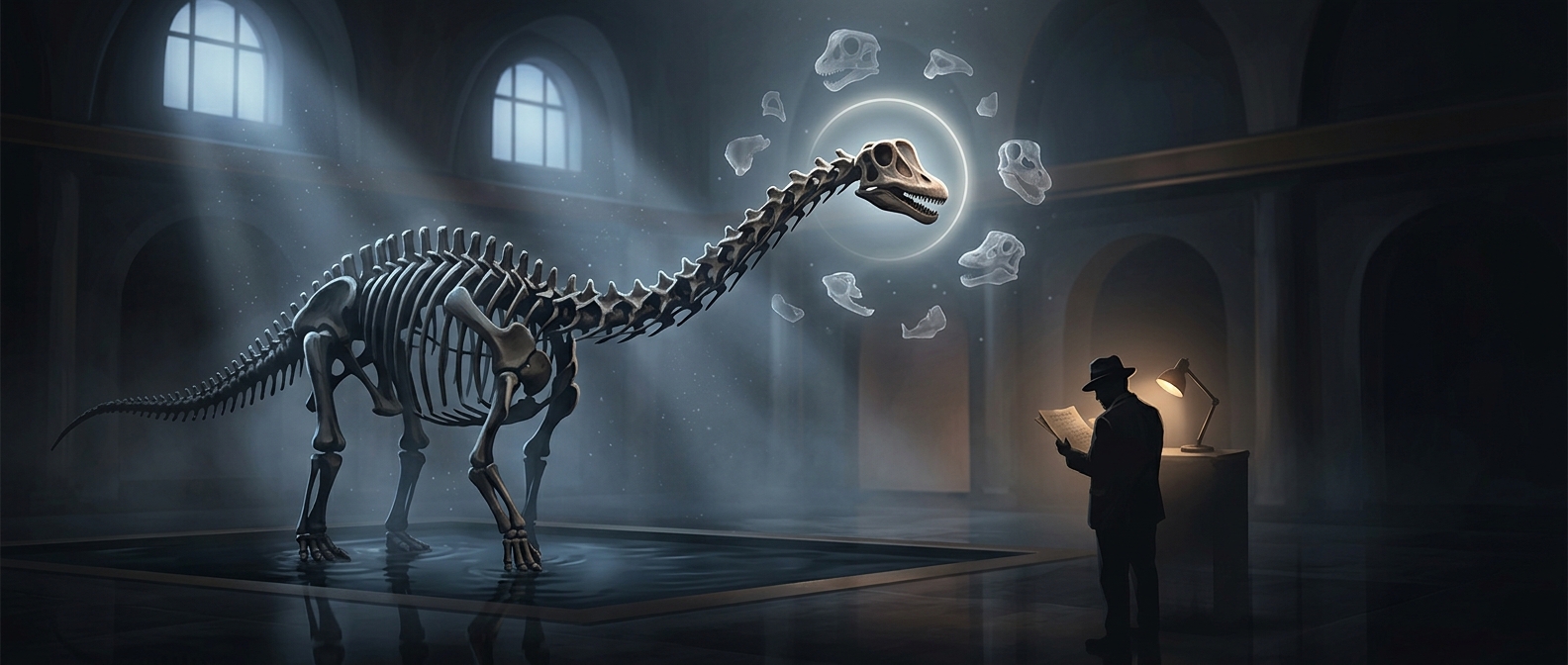
When paleontologists find a headless skeleton beside a skull, proximity can suggest they belong together, but it cannot prove it. Two animals may have died in the same area, and currents or scavengers may have mixed their remains. Early researchers sometimes had to make a best-fit assignment from incomplete evidence.
What a better fossil can change
A later specimen that preserves both skull and skeleton can provide a direct comparison. Researchers can examine whether the bones fit together and whether the skull’s features make sense with the body’s anatomy. If the skull differs sharply from the one previously assigned, the old pairing may have joined two animals that merely shared a burial site.
That correction can change more than a reconstruction’s appearance. Skull shape is often important for distinguishing dinosaur groups, so a misplaced head can lead scientists to describe an animal’s identity or relationships incorrectly. The lesson is that a fossil’s pieces need not have traveled together simply because they were found together: the animal in a museum display is sometimes a carefully tested reconstruction, not a single intact discovery.