How a Balloon Learned to Turn
A balloon rises because its hydrogen is lighter than the surrounding air. But lift alone offers no way to choose a route: the balloon travels with the air mass around it, so a change in wind can carry it somewhere its passengers never intended to go.
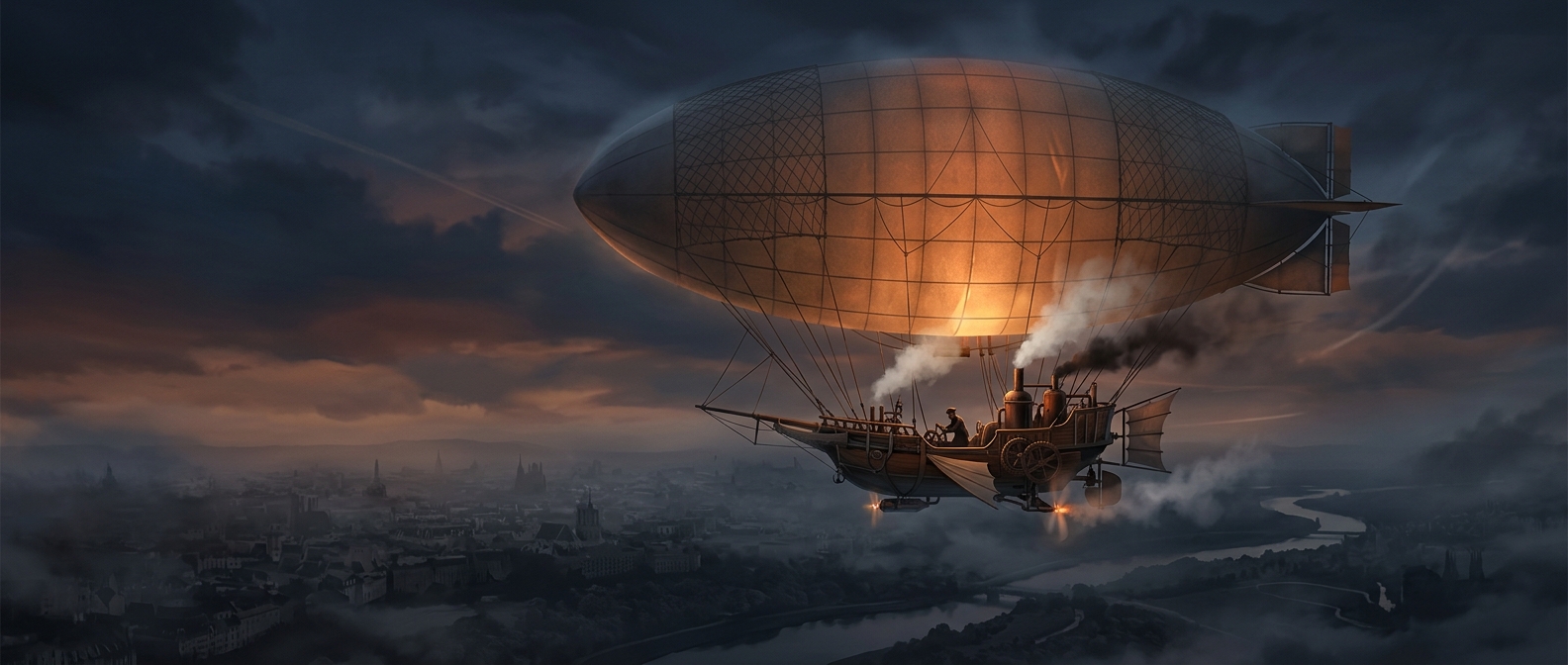
The key change was adding thrust—a force that moves a craft through the air. In 1852, French engineer Henri Giffard flew a hydrogen-filled airship powered by a small steam engine. The engine turned a propeller, which pushed air backward and the craft forward. A rudder at the rear could then redirect that airflow and swing the airship’s nose toward a new heading.
Steering Was Not the Same as Commanding the Wind
The propeller and rudder gave the pilot influence over direction, not complete freedom from the weather. The airship still moved within the wind, and its engine had to push it through the surrounding air to change its course. A weak breeze could still set the whole system drifting; a strong one could overwhelm the engine’s modest force.
That made the engine’s weight a difficult tradeoff. It had to be powerful enough to propel the craft, yet light enough that the hydrogen could lift the engine, its fuel, and the rest of the airship. Steam machinery also brought heat and a fire risk close to a bag of highly flammable gas. Giffard’s flight was therefore a practical demonstration of powered, directed flight—but not yet a reliable way to travel wherever one wished.
The important breakthrough was not that the balloon stopped depending on air currents. It was that, for the first time, propulsion gave its pilot a way to work against them.