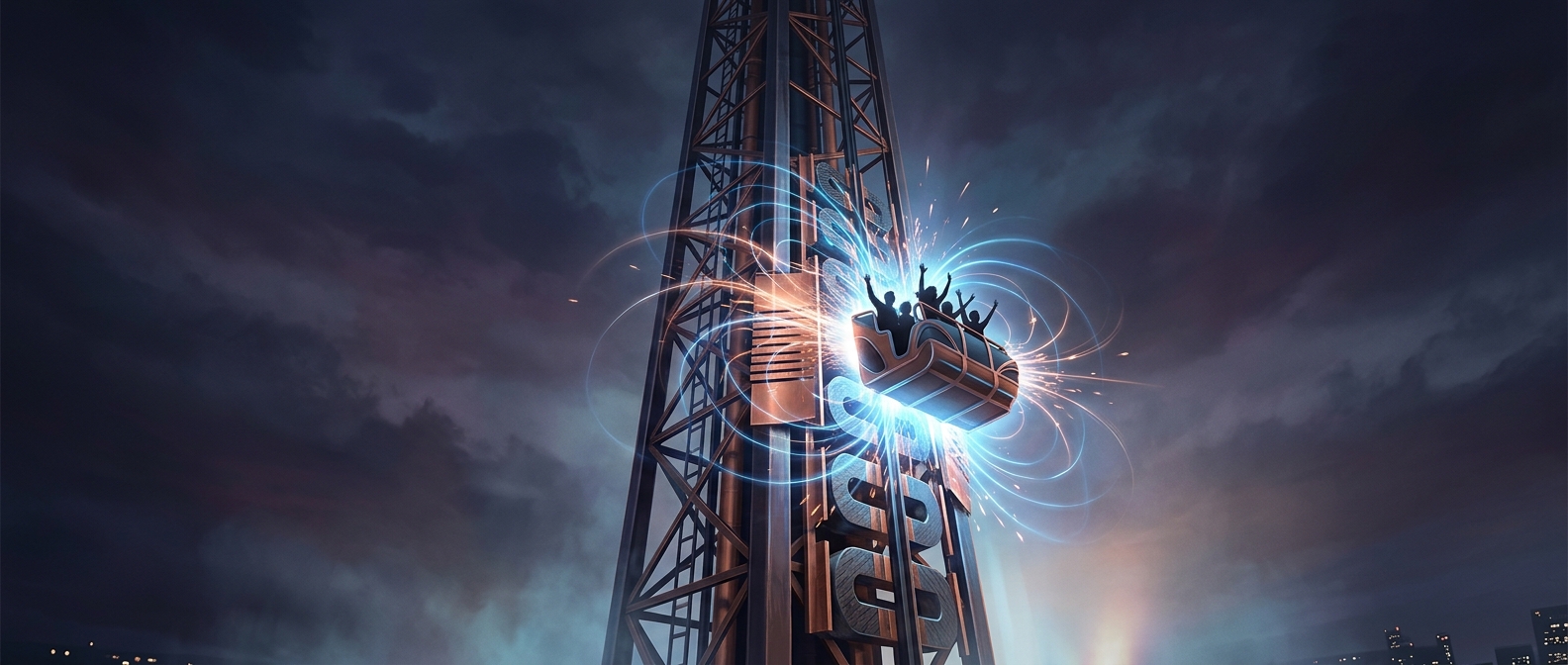
The tower’s brake is built into the track
A drop tower can slow its car without a powered brake at the bottom. As the car passes rows of metal fins, magnets attached to the car move past the conductive metal. Their changing magnetic field drives loops of electric current inside the fins, called eddy currents.
Those currents create their own magnetic field. By a principle called Lenz’s law, it opposes the change that produced it—in this case, the car’s motion past the fins. The result is a magnetic force pushing against the descent. The magnets and fins never need to touch.
Speed becomes heat
The resistance is not a rigid stop. The faster the car moves through the magnetic field, the stronger the induced currents tend to be, so the braking force grows with speed. As the car slows, the force weakens. That makes the system useful for reducing a rapid fall to a controlled arrival, rather than holding a car motionless by itself.
The car’s motion energy does not disappear: electrical resistance in the fins turns much of it into heat. The fins must therefore be designed to handle repeated heating as cars make successive runs.
A brake with no power connection
Because the braking force comes from motion through a magnetic field, this arrangement does not need electricity to activate a conventional motor or clamp. That makes it a valuable part of a ride’s stopping system, especially in a power interruption. It is not a substitute for every other safety measure, but it provides a strikingly simple physical backup: the faster the car rushes past the fins, the more strongly the fins resist it.