How a Rail Switch Guides a Train
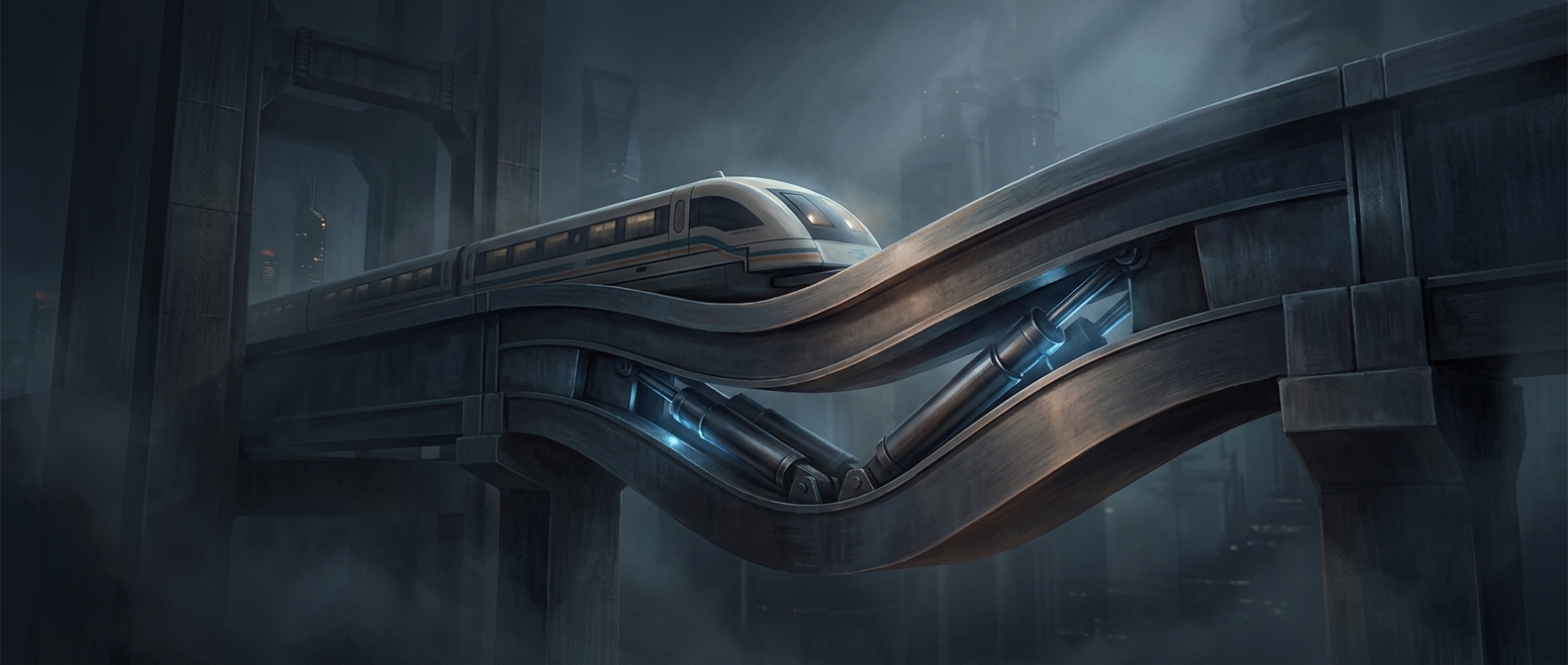
A railway switch works by moving a pair of tapered rails, called points, against fixed rails. A motor or trackside mechanism slides the points sideways. When one point lies tight against its neighboring rail, it closes the gap that would otherwise let a wheel continue along the other route. The wheel is guided onto the chosen track; the rails do not swing like a gate.
The points are shaped to meet the fixed rails gradually. That smooth transition matters because a train’s wheels are mounted in pairs on a common axle. Both wheels must follow the route together, even as the track curves away beneath them.
The Crossing Has Its Own Challenge
Farther along, the two routes cross at a component called a frog. Here, one rail must make room for the other, leaving a small gap where a wheel briefly lacks a continuous rail beneath it. The wheel’s flange—the raised inner rim that helps keep it on the track—passes through that gap. Nearby guide rails help keep the wheel aligned as it crosses.
This is why a switch is more than a movable pair of rails: its points steer the wheels, while the crossing lets the intersecting rail paths pass through one another without colliding.
Why Position Must Be Certain
Before a train is routed through a switch, the points must be set for the intended path and held there. Railway signaling systems coordinate that position with permission for a train to proceed; a train should not be sent through if the route is not safely established. The result is a deceptively small piece of trackwork that can redirect an enormous train—one wheelset at a time.