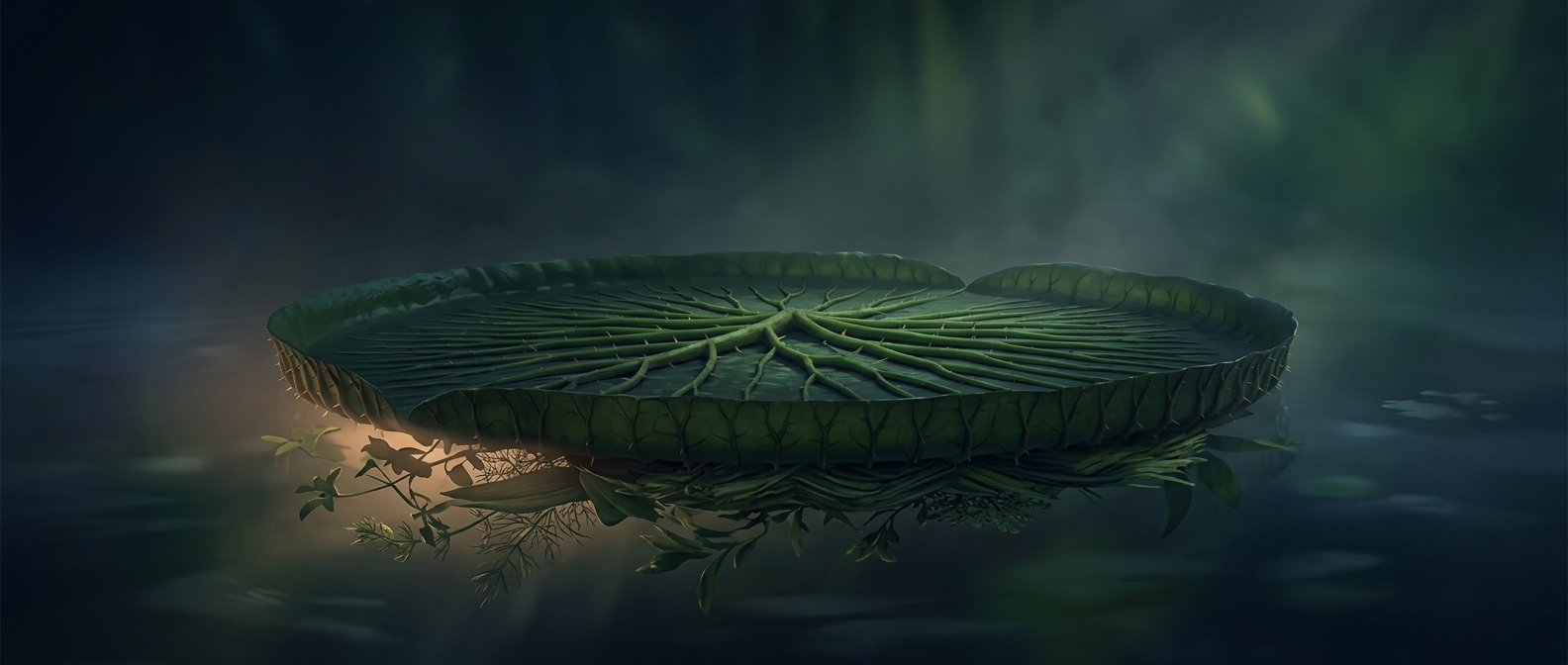
A Floating Platform Built From Ribs
A Victoria amazonica leaf is not a flat sheet of plant tissue. On its underside, a network of raised ribs radiates from the center and branches into smaller supports, much like beams beneath a floor. The rim curls upward, helping the broad leaf keep its shape instead of folding at the edges.
The pad floats because it displaces water: as it settles slightly under a load, it pushes aside more water, whose upward force helps hold it up. The ribbed framework spreads pressure across the leaf, so a modest load can be supported rather than concentrated in one fragile spot. That is why a baby can appear to sit on one in demonstrations—but the display is not a safe invitation to put a child on a living plant.
Spines Make the Underside a Rough Neighbor
The ribs are studded with sharp spines. When leaves press against one another, those spines can tear or puncture neighboring vegetation, giving the lily pad a way to damage plants competing for the same patch of water and access to sunlight.
From above, the pad looks like a smooth green table. Below the surface, its bristling framework does two jobs at once: it helps the leaf stay spread over the water and makes close contact costly for nearby plants.