Why a Train Can Slow Down Far From the Power Feed
A model train draws current through its wheels and rails. But rails are not perfect conductors: as current flows through their small electrical resistance, some voltage is lost along the way. The longer the path from the power connection, the greater that loss can become, especially when the train is pulling harder and drawing more current.
The motor responds to the voltage it actually receives, not the setting on the controller. If less reaches the far end of the layout, the train may run more slowly there than it does near the feed.
More Feeds Shorten the Electrical Path
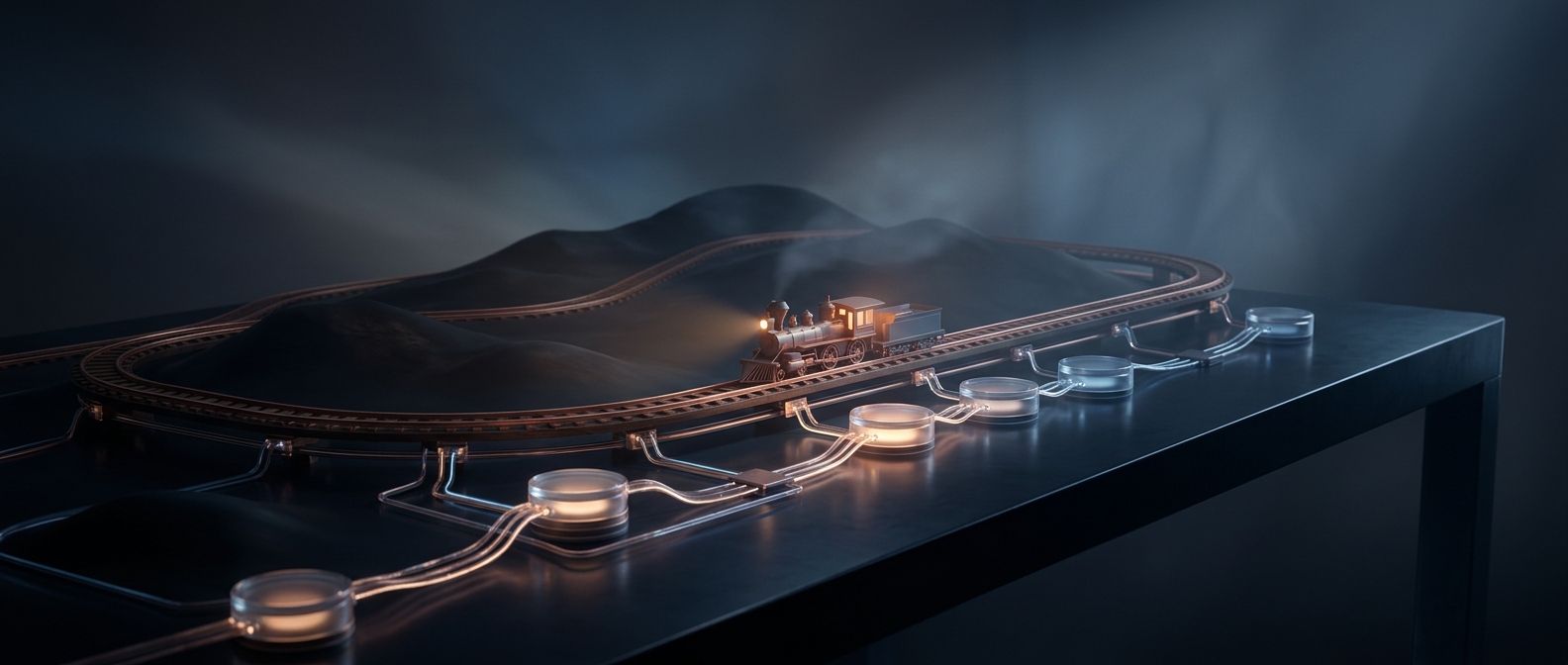
A common fix is to add feeder wires: short connections from the power supply or a distribution wire to the rails at several points around the layout. These feeds give electricity additional routes into the track, so a train far from the original connection does not depend on one long stretch of rail to carry all its current.
The added feeds do not make the rails’ resistance disappear. Instead, they reduce how much track the current must travel through before reaching a train. That helps keep the voltage more consistent across the layout, including when the train is moving or climbing a grade and its motor needs more current.
The Layout’s Size Changes the Need
A small loop may work well with a single connection. On a larger layout, voltage differences can become noticeable, and rail joints can add further resistance if their electrical contact is poor. Distributing feeds around the track helps prevent one distant section from becoming the weak link.
The practical test is simple: if a train runs strongly near the power connection but noticeably slows in another section, the problem may be voltage reaching the rails—not a change in the train itself.