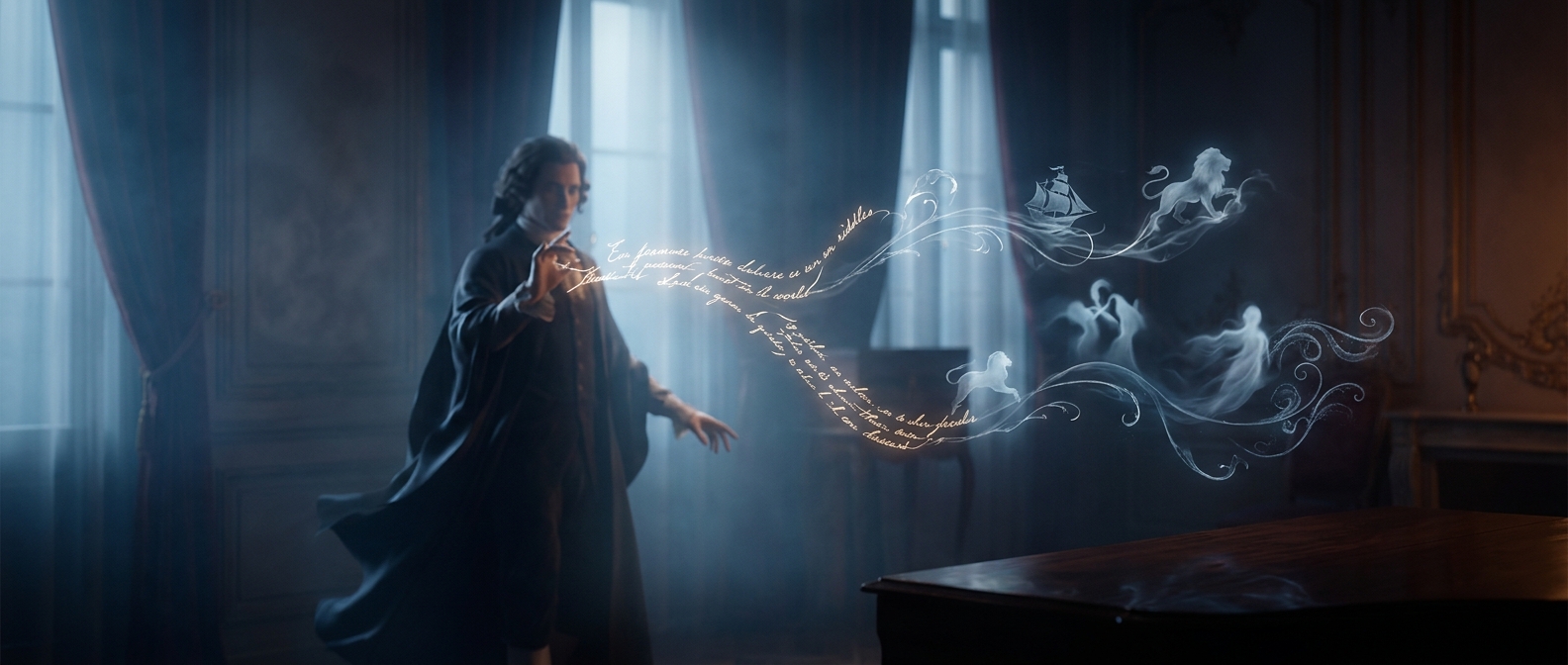
A word became a sequence of clues
Early charades treated a word as a small puzzle to be solved on paper. Players might break a word into syllables, then offer a riddle for each part and another for the complete word. The challenge was not simply to guess a hidden answer: it was to recognize how several clues could fit together.
That structure made the game easy to adapt. A player could write a neat, compressed riddle, but the same clue could also be expressed through a gesture, a pose, or a miniature scene.
From reading to watching
When charades moved into pantomime, the underlying puzzle stayed intact while its delivery changed. Instead of reading a clue, an actor could embody a syllable; other players had to infer the intended word from movement and context. The room’s attention shifted from the wording of a riddle to the performance—and to the audience’s guesses.
That change suited a social evening. A written puzzle asks people to interpret language, often quietly; pantomime gives everyone something visible to react to, while keeping the answer concealed. The performer’s limited tools—body, expression, and timing—turn the same word puzzle into a shared spectacle. Charades became livelier not by abandoning riddles, but by making the clues something people could watch.