A Pivot Turns a Hand Squeeze Into Jaw Force
Pliers work as a pair of levers joined at a pivot. The handles are the long ends; the jaws are the short ends. When you squeeze the handles, the pivot concentrates that effort at the jaws. Because the handle ends are farther from the pivot than the gripping surfaces, the jaws can press harder than your fingers could directly—though they move a shorter distance in return.
That tradeoff suits tasks such as holding a small object steady or gripping something too hot or sharp to touch. The pivot also keeps the jaws working in opposition, so the tool can clamp an object rather than merely push it from one side.
A Simple Shape With Few Ways to Improve It
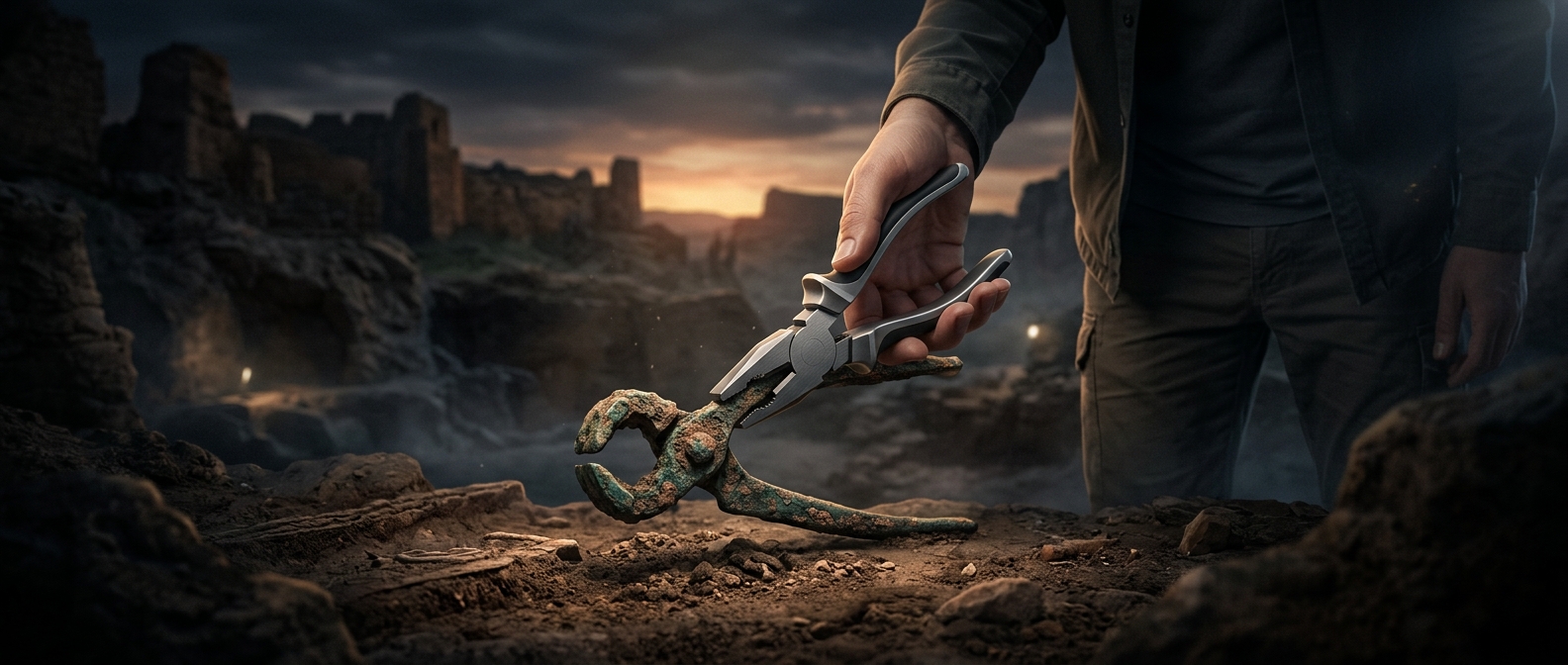
The basic arrangement solves a durable mechanical problem with very few parts: two arms, a joint, and gripping ends. Changing the jaw shape can make a tool better for cutting, bending, or reaching into a tight space, but those are variations on the same lever-and-pivot arrangement. A more elaborate mechanism would add parts and potential failure points without necessarily improving an ordinary grip.
Materials, manufacturing, and details such as handles can change substantially even when the overall geometry remains familiar. The design’s longevity is not a sign that pliers never developed; it reflects how effectively a pivot converts a hand’s motion into controlled gripping force. The enduring innovation is the leverage built into the shape.