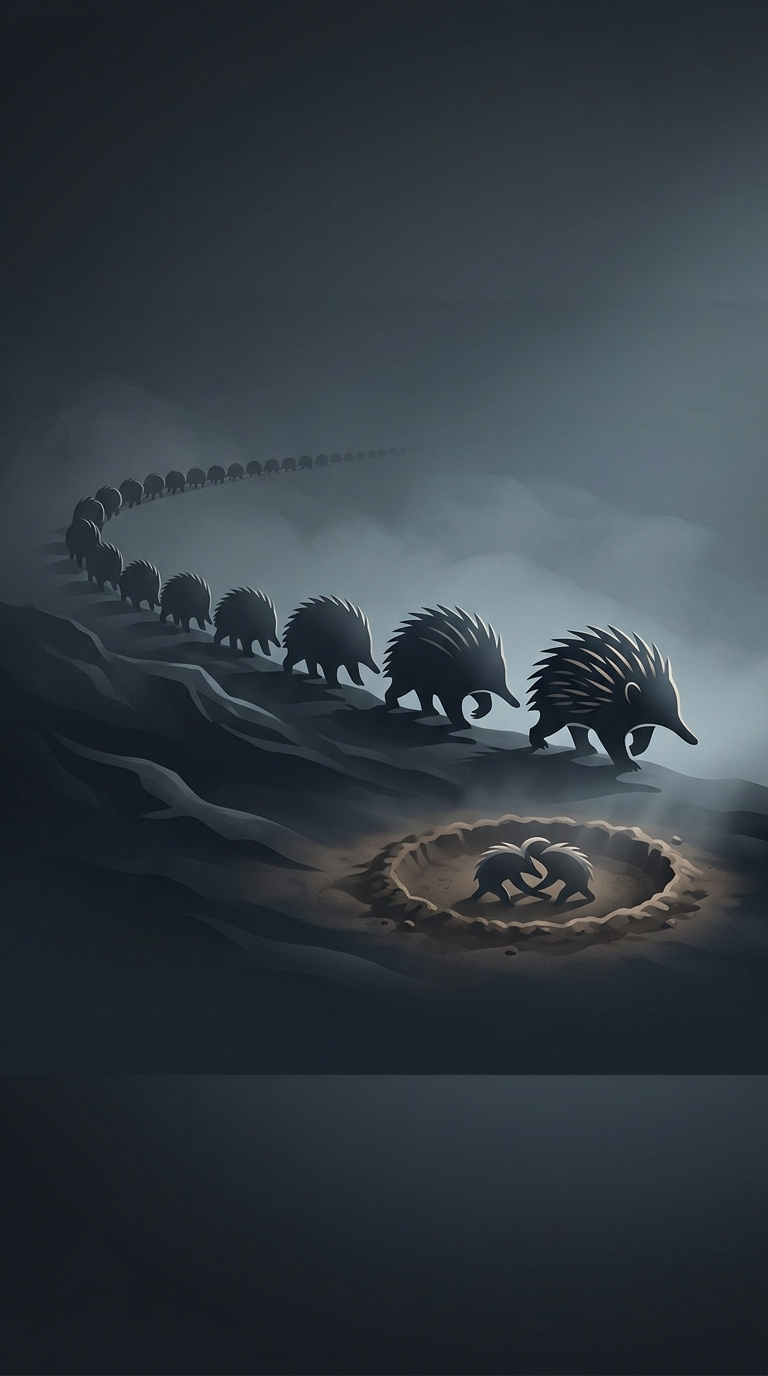
How an echidna mating train forms
During the breeding season, a female short-beaked echidna can attract several males, which follow her nose-to-tail across the ground. The procession is temporary: it is a gathering around one breeding opportunity, not a lasting social group. Echidnas are usually solitary, so the train is an unusual, brief shift from their normal way of life.
Following a female can continue for days or even weeks. The males may line up roughly by size, with larger animals nearer the female. Their close tracking is possible in part because echidnas rely heavily on smell; a long snout and sensitive nose help them investigate scents along the ground.
The contest moves from pursuit to pushing
When the female is receptive, competition can become physical. Males dig a shallow circular trench around her, then shove and wrestle one another, trying to push rivals out. The contest is not a coordinated ritual so much as a test of persistence and strength: the male left in the ring may get the opportunity to mate.
The trench gives the struggle a boundary, while the female’s position at its center makes the stakes clear. But the procession does not guarantee a mating. If the opportunity passes, the males disperse, and the temporary gathering ends.
A brief exception to solitary life
Echidnas do not maintain pair bonds or raise young as a group. After mating, the female’s reproductive path is strikingly different from that of most mammals: she lays a single soft-shelled egg, which she carries in a temporary pouch. The train is therefore a concentrated bout of competition, not the start of a shared family life—a crowd assembled for one chance, then gone.