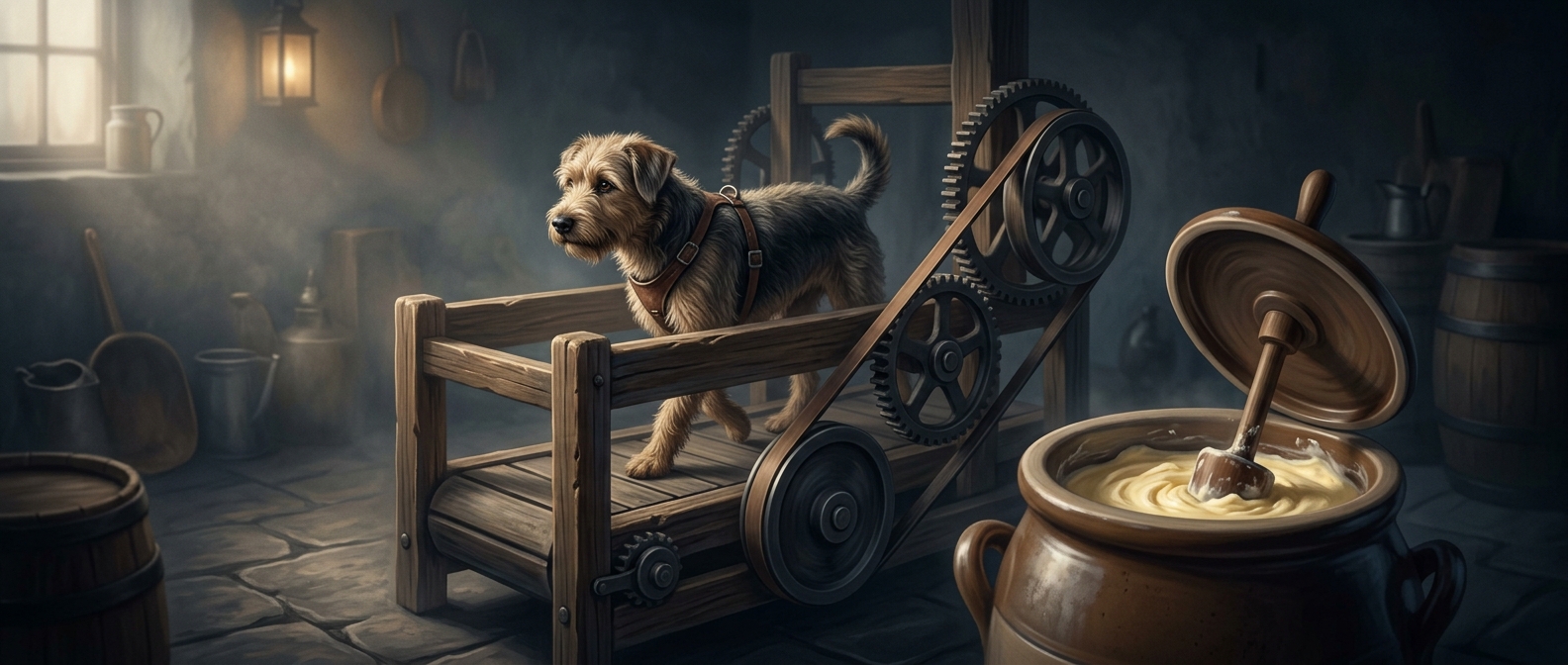
How a dog’s steps reached the churn
In some kitchens, a dog worked inside a large wooden wheel mounted on its side. As the animal walked, its weight turned the wheel, much like a person walking on a treadmill. A belt, cord, or mechanical linkage carried that rotation to a butter churn, whose dasher—the paddle inside—stirred cream until its fat clumped into butter.
The setup converted a steady walk into a repetitive kitchen task. Instead of someone continuously working a handle, the dog supplied the motion while a person could tend other chores. The wheel’s size and connection to the churn mattered: the motion had to be steady enough to agitate the cream, but the arrangement did not need to be fast or powerful.
A small engine with limits
This was animal power on a household scale, not a machine for producing butter in bulk. It made most sense where a suitable dog and a churn were already available, and where the apparatus could be fitted into a working kitchen. The dog still needed to keep walking; the wheel did not store energy or run by itself.
The design also shows how domestic technology often borrowed from larger machinery. A wheel captured an animal’s movement, and a simple transmission redirected it to a tool. In this case, a dog’s ordinary steps became the churn’s steady beat—turning kitchen labor into a task powered by paws.