How Foote tested gases with sunlight
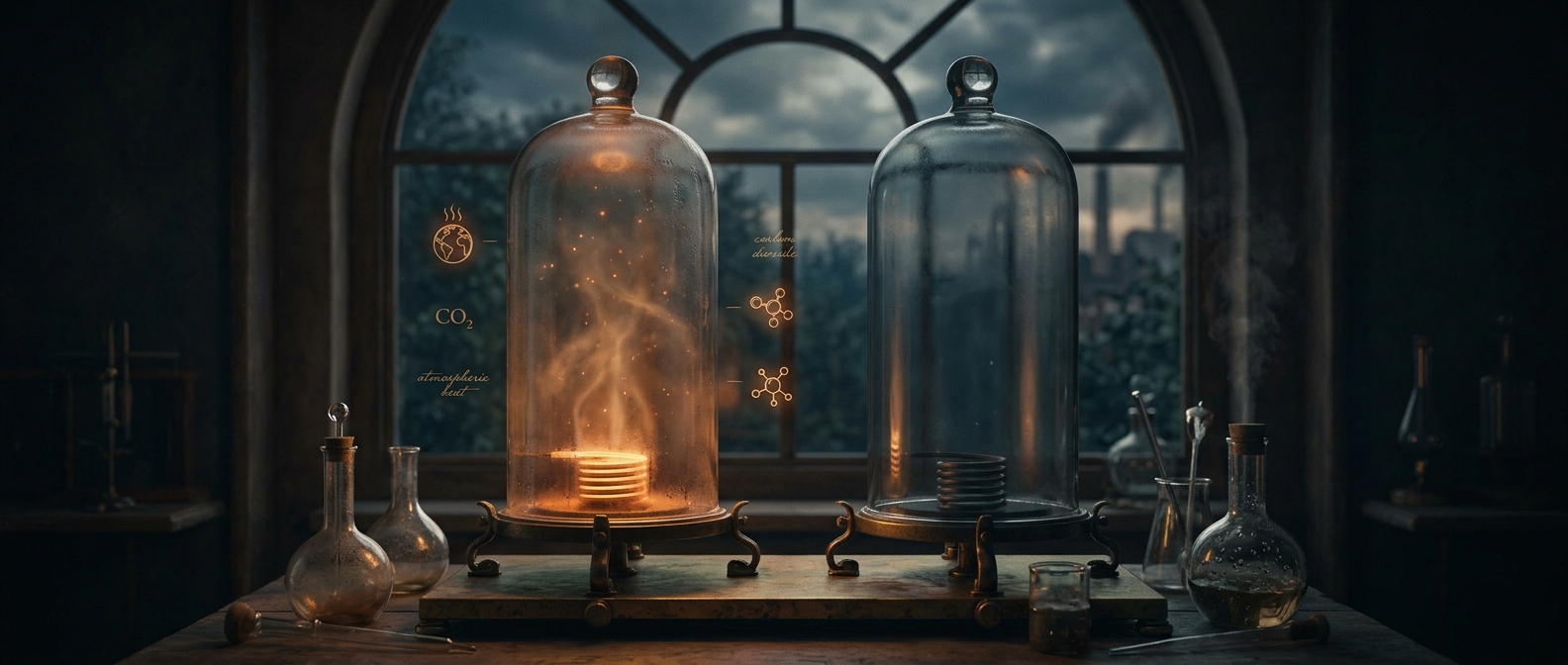
In 1856, American scientist Eunice Foote placed different gases in glass cylinders and exposed them to sunlight. She compared how warm each cylinder became. The cylinder containing carbon dioxide heated more than the one filled with ordinary air, and it also took longer to cool. Foote concluded that changes in the atmosphere’s composition could affect Earth’s temperature.
Her apparatus was simple: a thermometer inside each cylinder let her track warming and cooling. The experiment showed that carbon dioxide responded strongly to sunlight and retained warmth under her test conditions. It was an early clue, not a direct model of the full atmosphere.
The atmosphere’s version works differently
Sunlight mostly reaches Earth as visible light, which passes through the atmosphere and warms the ground and oceans. The warmed surface then sends energy upward as infrared radiation—a form of light that people feel as heat but cannot see. Carbon dioxide absorbs some of this infrared energy and releases it again in different directions, including back toward the surface. That slows the loss of heat to space.
Foote’s cylinders did not reproduce this whole process. In particular, they did not isolate the role of infrared radiation in the way later work on the greenhouse effect would. Her result nevertheless pointed to an important physical connection: atmospheric gases can change how heat moves through a system.
A finding presented by someone else
Foote’s paper was presented at a scientific meeting by a man, rather than by Foote herself. That detail matters to the story of the experiment: the result entered the scientific record, but its author did not deliver it in person. The cylinders made an atmospheric question tangible—change the gas, and the thermometer responds—while the modern explanation shows why Earth’s atmosphere can hold onto some of its outgoing heat.