Why a Ship-Stabilizing Spring Walked Instead
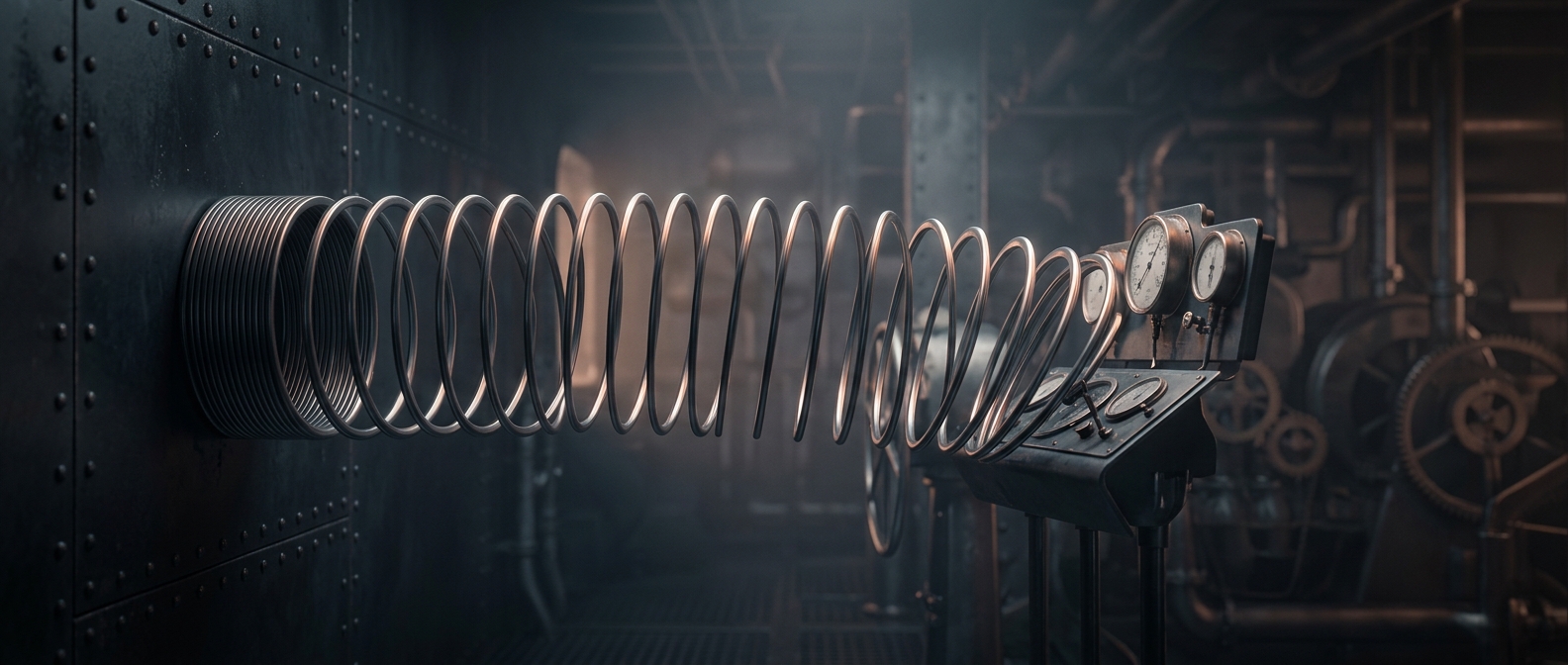
A ship’s rolling and pitching can make delicate instruments harder to keep steady. A spring can help absorb or counter movement, but a useful stabilizer must respond in a controlled way and return the instrument toward a workable position. A loose spring that keeps moving after a bump would be a poor match for that job.
The Slinky’s prototype revealed exactly that kind of uncontrolled motion. Once the spring tipped over an edge, gravity pulled its upper coils downward. Each coil’s movement shifted the balance of the coils still upright, tipping the next one in turn. The result was a traveling wave of collapses: the spring seemed to step down the books instead of simply falling in a heap.
The Failure Was a Demonstration
That motion made the prototype unsuitable for its intended purpose, but it also made the spring’s behavior immediately visible. Unlike a spring that merely stretches and rebounds, this one could pass a movement along its length, coil by coil. Its form and flexibility turned a small tilt into a repeatable sequence.
The practical lesson was a change in what counted as success. For ship equipment, the spring needed to steady something; for a toy, the cascading motion was the attraction. A failed test had exposed a different use built into the same design. Children could set the spring at the top of steps and watch gravity carry it downward, one coil tipping into the next.