From coal haul to cliffside ride
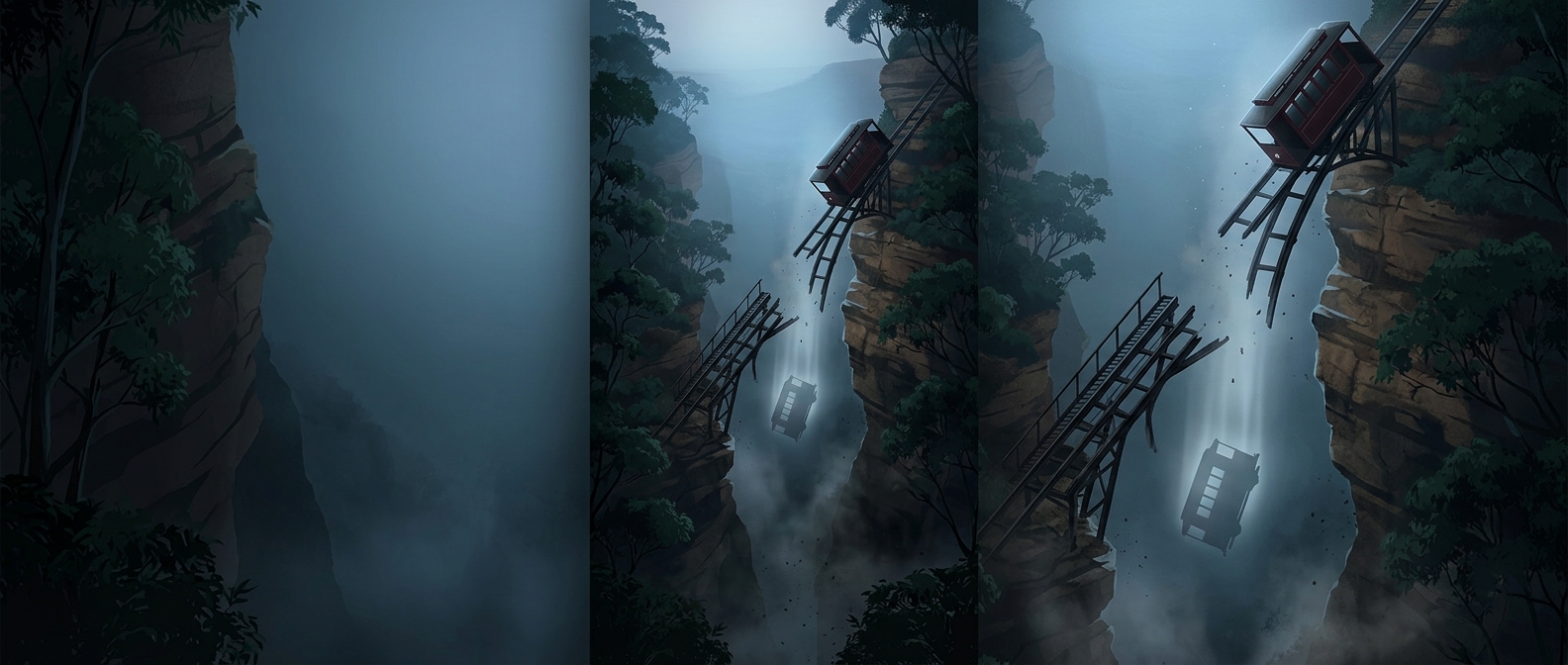
The steep railway at Scenic World in Australia’s Blue Mountains began as working infrastructure, not a thrill ride. In the late 19th century, an incline railway carried coal and shale from mines in the Jamison Valley up the escarpment to the plateau above. The route opened in 1878, when hauling fuel out of the valley was its practical purpose.
The slope is often described as 52 degrees. That is an angle measured from the horizontal—not a 52 percent gradient—so the track rises or falls extremely sharply over a short distance.
How the descent works
Rather than relying on a locomotive to grip the track on such a slope, an incline railway uses cables to move its cars. The cars are linked so that one traveling downhill helps pull another uphill; a powered winding system controls their movement. This arrangement turns a route too steep for an ordinary railway into a controlled climb and descent.
For passengers, the track’s angle makes the valley seem to open beneath the carriage. The sensation comes from following the old industrial line down the escarpment, not from a train racing freely down a hill.
The mine route becomes the attraction
As mining declined, the line found a new use carrying visitors into the valley. Its transformation preserved the basic idea of the route while changing what the journey was for: a haulage line became a way to experience the steep terrain up close. The memorable ride is, in effect, a trip through the valley’s industrial past—on the same kind of path once used to bring its resources out.