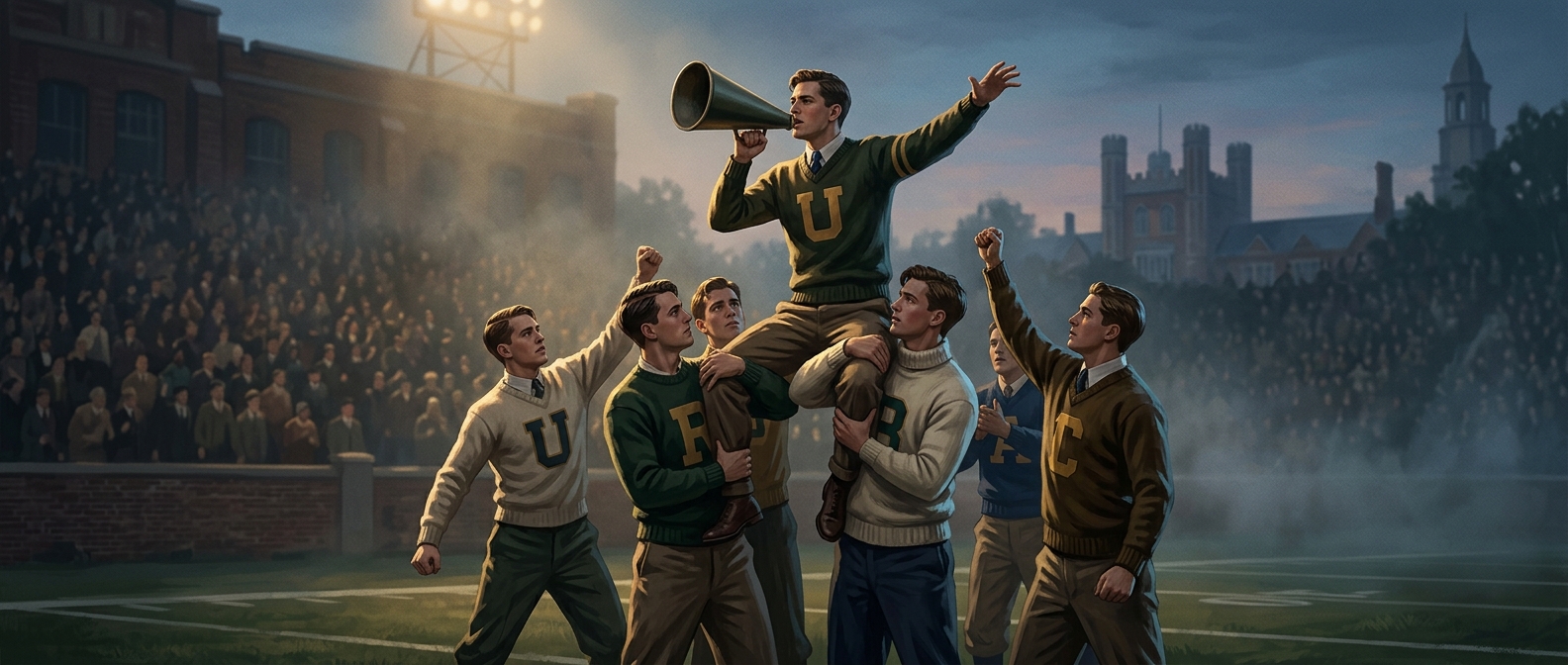
How a student yell leader could organize a stadium
Early college cheerleading was less a performance than a way to coordinate a crowd. A football stand could be loud and scattered: spectators were watching different parts of the field, and one person’s shout might disappear into the noise. A student leader gave people a common cue. Short, repeated chants and emphatic gestures made it easier for hundreds of voices to join in at once.
That role suited the college social world in which the tradition took shape. The leaders were male students, not a separate squad of acrobats. Their authority came from projecting a chant, keeping its rhythm, and persuading the stands to answer. The central skill was not athletic display but crowd direction.
From leading chants to performing routines
As cheerleading changed, its job expanded. Organized groups began adding coordinated movement and, eventually, lifts and stunts—elements that made the cheerleaders themselves part of the spectacle. That shift changed what audiences watched: the crowd was still meant to respond, but the squad also had to hold attention with a planned performance.
The distinction matters because modern images of cheerleading can make its athletic routines seem like the tradition’s starting point. They were a later layer. The original innovation was simpler and social: one student supplied a beat and a phrase that let a stadium act, briefly, like a single voice. Before the spectacle took to the air, its main instrument was the crowd.