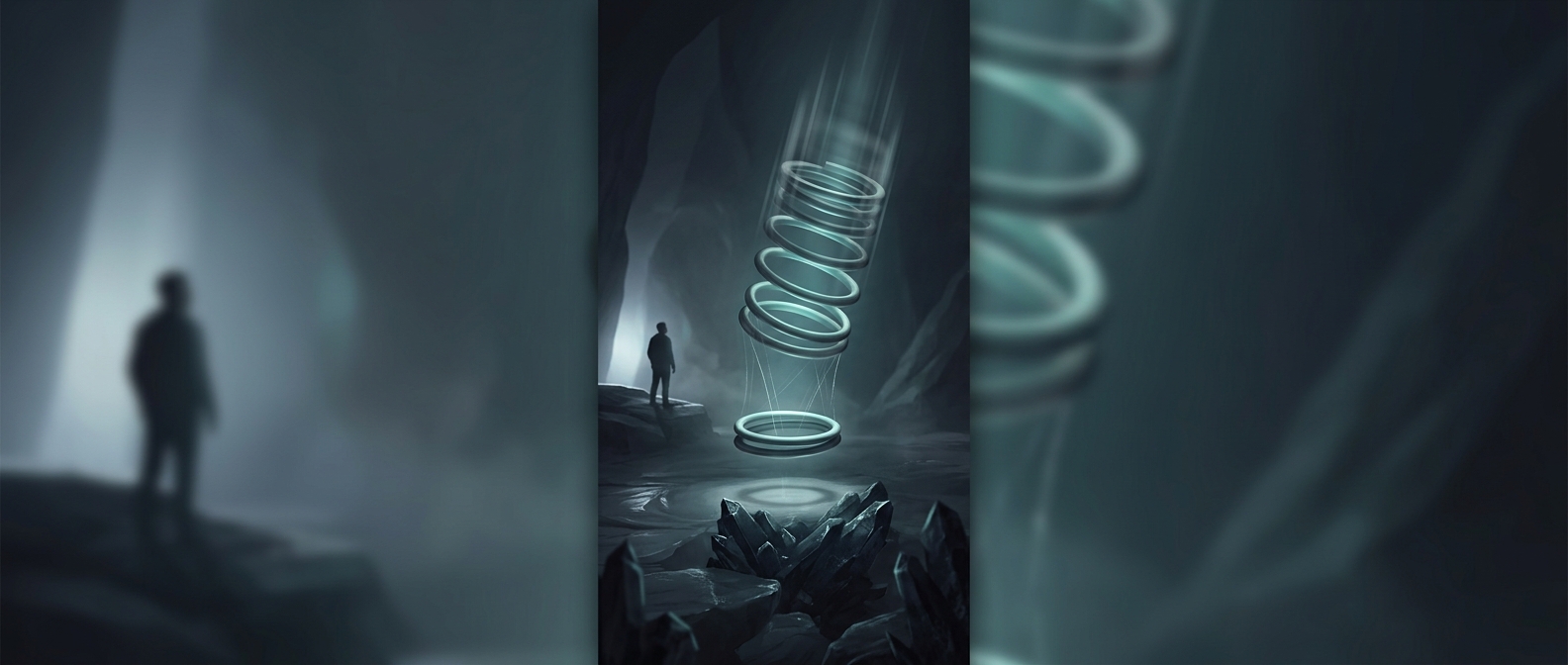
A spring does not change tension everywhere at once
A stretched spring is in balance before it is released: its pull at each point supports the weight of the coils below that point. Near the top, the spring must support almost all the coils; near the bottom, it supports only a few. So the tension is greater at the top than at the bottom.
When the top is let go, the spring near it begins to shorten and its tension changes. But coils farther down cannot respond instantly. The change travels through the spring as an elastic wave—a moving disturbance passed from one coil to the next, rather than a signal carried by any material object.
The bottom keeps its old support—for a moment
Until that disturbance reaches the lower end, the tension there is still close to what it was before release. That old pull balances the weight of the lower coils, so the bottom remains nearly where it was while the upper part falls. Once the changing tension arrives, the balance is lost, and the bottom starts to descend.
The delay is brief, but visible because the spring is long and its mass is spread along its coils. The wave’s speed depends on the spring’s stiffness and mass, so different springs—and different ways of stretching them—can produce different pauses. What looks like the bottom defying gravity is really a record of how long a mechanical change takes to travel through an object.