Finding a position without a horizon
A submarine crossing beneath the Arctic could not steer by landmarks or check its position against the sky. Nautilus instead relied on inertial navigation: gyroscopes helped it maintain a reference direction, while accelerometers measured changes in movement. From those measurements, the crew’s system estimated how far and in what direction the submarine had traveled.
That is a form of underwater dead reckoning, and it has a weakness: small measurement errors build up over time. Without being able to surface for a fix, the crew had to trust the instruments and the route planning rather than repeatedly compare their estimated position with visible landmarks.
The ice was a ceiling—and a hazard
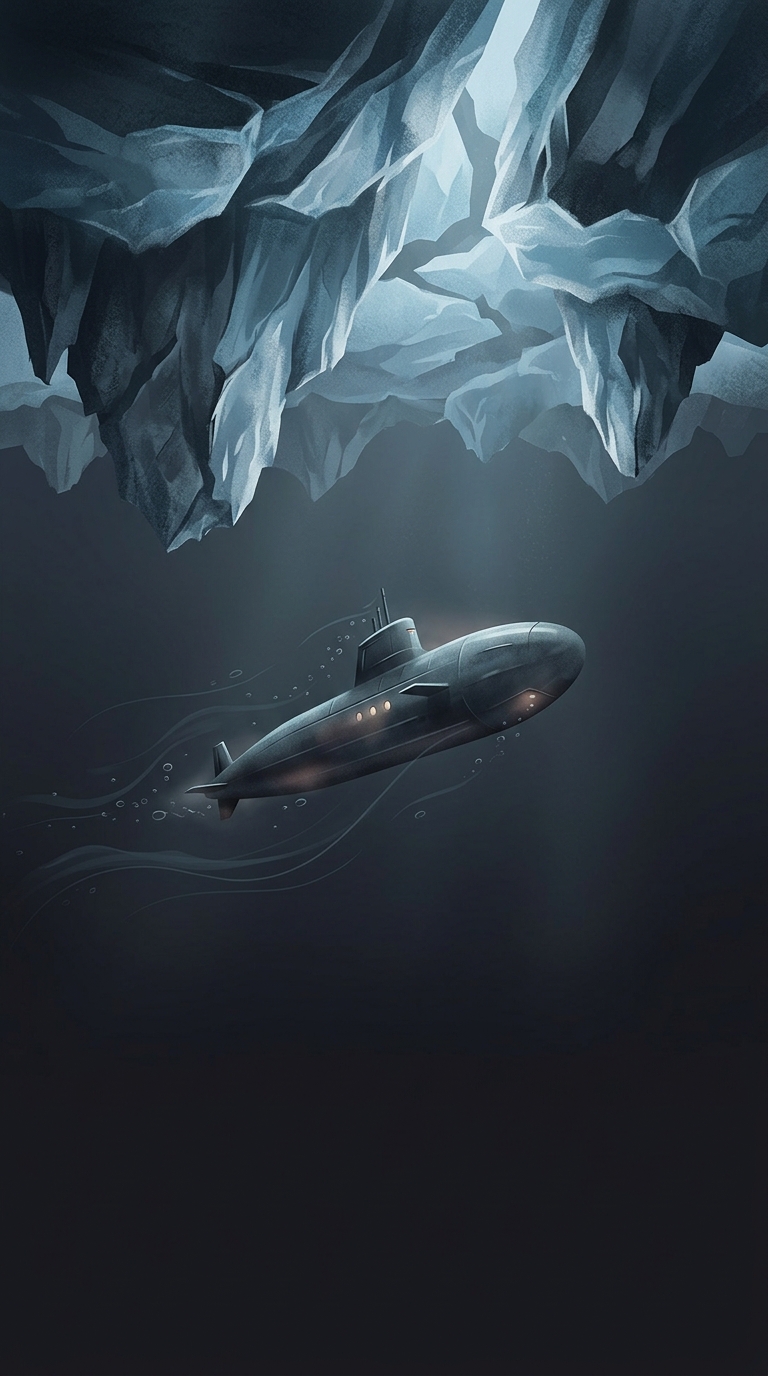
The submarine also had to manage its depth in a space bounded by ice above and the seabed below. Arctic ice is not a smooth, level roof; its underside can dip into deep ridges. A route that looks safe on a chart could leave too little room between a ridge and the bottom.
That made depth control more than a matter of avoiding the ocean floor. Nautilus had to preserve clearance overhead as well, while continuing forward without a convenient place to rise. The crossing therefore depended on keeping track of both the submarine’s position along its route and its vertical room to maneuver.
Why the reactor changed the journey
A conventional submarine’s underwater endurance is constrained by its need to replenish air for its engines. Nautilus’s nuclear reactor supplied power without that surface-dependent cycle, making a prolonged submerged passage practical. It did not make Arctic navigation easy; it removed one major reason the vessel would otherwise have had to come up.
The achievement showed that a submarine could travel across a region where the usual escape route—simply surfacing—was blocked. Under the ice, navigation meant trusting a calculated position while managing a ceiling that could reach down toward the boat.