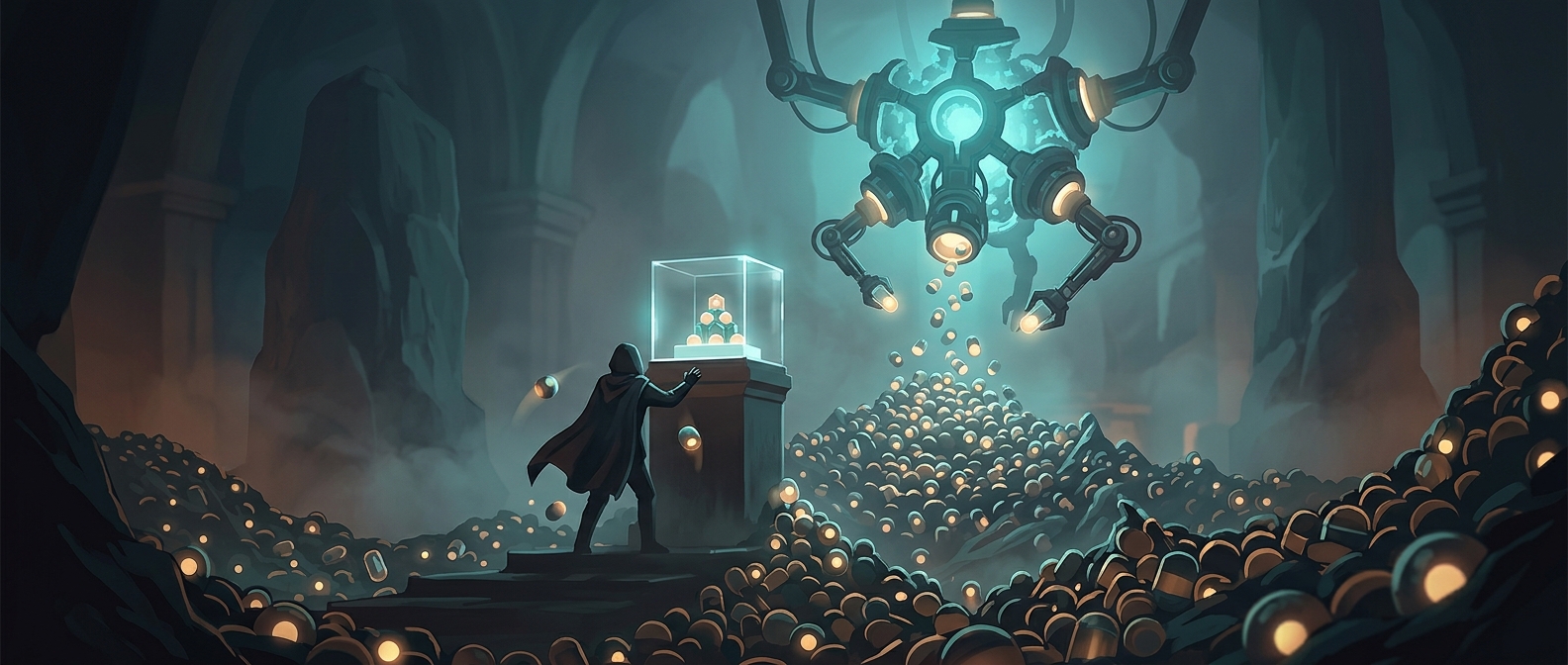
Why the last card is so hard to find
Suppose a set has 50 equally likely cards, and each pack contains one card drawn at random. When your collection is small, most possible cards are still missing, so a new pack is likely to add something. As the collection fills, the odds shift: with 49 cards already collected, only one of the 50 possible draws completes the set. The other 49 produce duplicates.
This is an example of the coupon collector problem: how many random draws does it take to collect every type? The key is that the odds change as you go. Early draws have many chances to find something new; the final missing item has only one.
Why “one more pack” adds up
For a particular missing card, each pack has a 1-in-50 chance of containing it. The chance of missing it repeatedly shrinks with every pack, but does not vanish after a handful. After 50 packs, for example, the chance of still not seeing that specific card is about 36%: each pack has a 49-in-50 chance of not being it, and those chances multiply.
That does not mean every collector needs the same number of packs. Random runs vary: one person may get lucky early, while another gets a long streak of repeats. And if several cards are missing, any of them can count as a new find. The slowdown becomes most dramatic when only one or two gaps remain.
The practical consequence
A set’s size can make completion feel deceptively close. Having nearly every card does not mean the remaining ones are nearly guaranteed to appear; it means each pack has fewer ways to help. That is why trading duplicates can be more useful than continuing to rely on chance: a repeat that is worthless for filling your own last slot may be exactly the card another collector needs.