Why Minecraft’s Far Lands Appeared
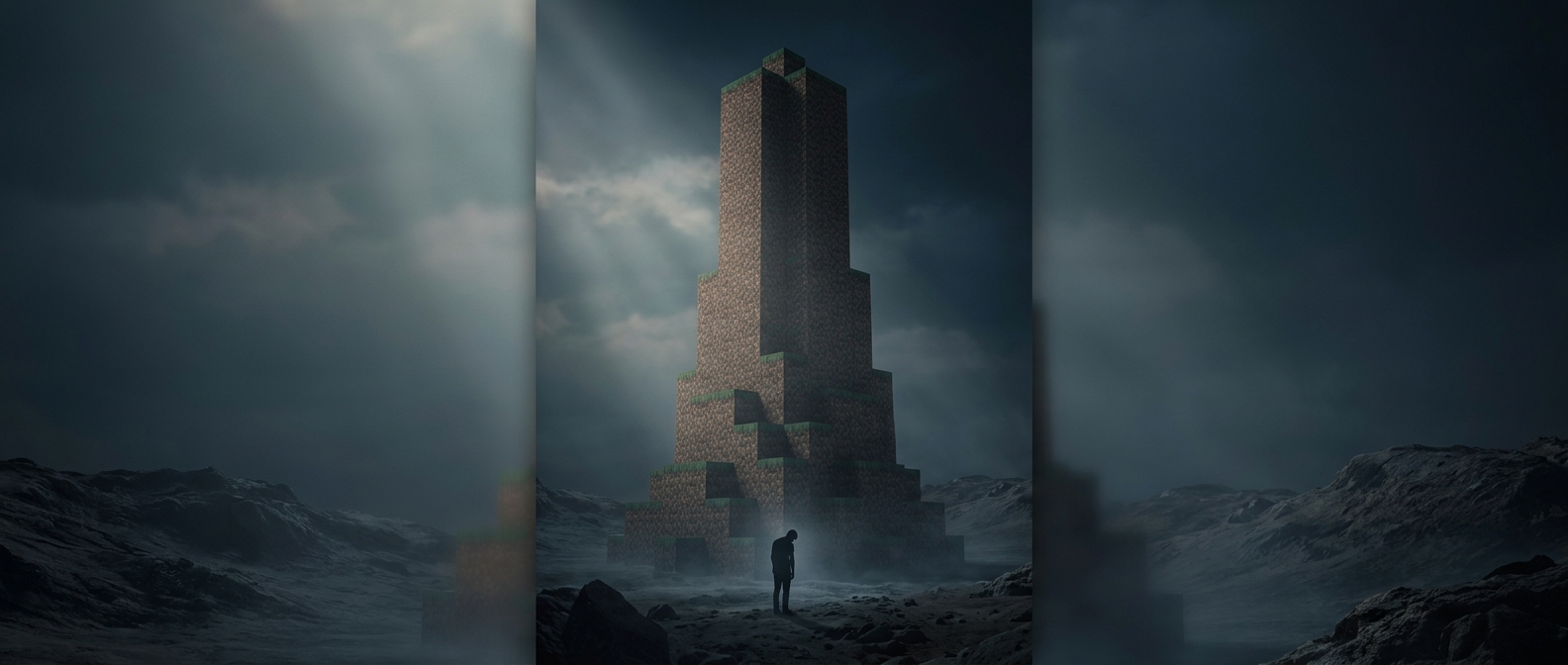
The Far Lands were not a deliberate map boundary. In early versions of Minecraft, they formed when the game’s terrain-generation calculations began misbehaving far from the world’s center. Those calculations use mathematical noise—controlled randomness that helps create natural-looking hills and valleys. At extreme coordinates, limited numerical precision distorted the noise, turning ordinary terrain into towering, jagged formations.
The result looked like a colossal wall, but it was a glitch in how the world was drawn, not the end of a designed landscape. The phenomenon appeared roughly 12.5 million blocks from the origin, the point where the game’s coordinates begin.
A Long Walk Through a Technical Limit
Minecraft blocks are also units of distance, so reaching that location meant traveling millions of blocks in one direction. At a steady pace, the trip could take more than 800 hours of uninterrupted play—over a month without stopping. In practice, movement, terrain, and the demands of keeping a game running make that a very different undertaking from simply holding a direction key.
The distance reflects a tension in procedural worlds: a game can generate terrain on demand instead of storing every landscape in advance, but its calculations still have limits. Far from the center, tiny rounding errors can accumulate until the landscape-generation system produces something dramatically unlike its intended hills and valleys.
A Landmark From Minecraft’s Earlier Era
The classic Far Lands belong to older versions of the game; later terrain-generation changes removed that familiar formation. They remain memorable because they made an invisible engineering limit visible: keep walking long enough, and a small flaw in the math could become a landscape so vast that reaching it took weeks of continuous play.