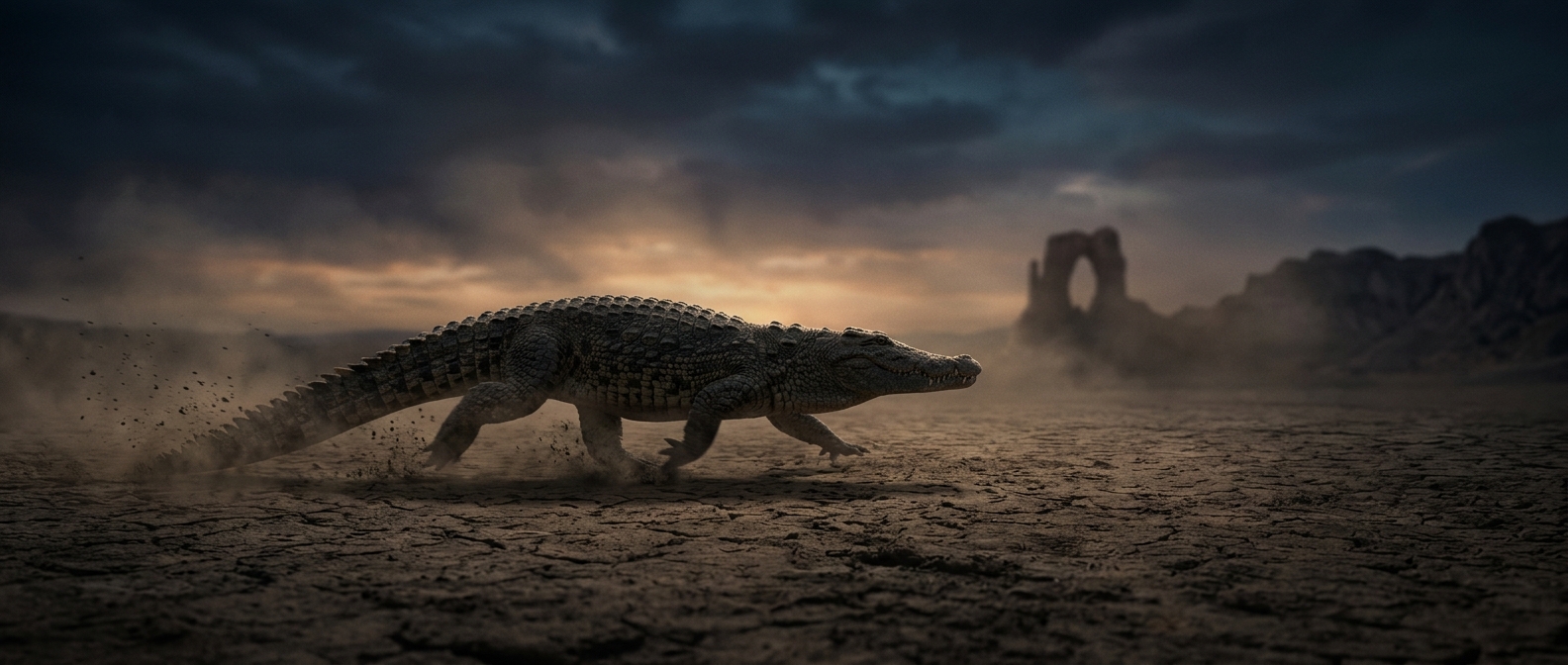
How a Crocodile Gets Its Whole Body Off the Ground
A crocodile’s familiar belly-low crawl is only one way it can move on land. In a gallop, it raises its body and bounds forward, briefly supporting its weight on its limbs rather than dragging its underside across the ground. The animal’s legs, usually held out to the sides while crawling, take a more upright position to lift and propel its heavy body.
The movement is possible because crocodiles have more than one land gait—the pattern of steps they use to travel. A slower, higher walk also keeps the body raised, but a gallop is a faster, more forceful burst. It can look surprisingly springy for an animal built with a long, heavy body and short legs.
A Burst, Not a Long-Distance Run
Galloping takes coordination and effort, so it is useful for short movements rather than sustained travel. Crocodiles are adapted primarily for life in and around water; on land, their weight and body shape limit how long they can keep up a fast pace. A gallop lets one cover ground quickly when the situation calls for it, but it does not make the animal a distance runner.
That distinction matters when watching a crocodile away from the water. Its low crawl can make it seem as though it can move only slowly, but a sudden gallop shows a different side of its anatomy: limbs strong enough to lift the body and drive it forward in bounds. The surprising part is not simply that a crocodile can run—it is that its usual ground-hugging posture is only one option.