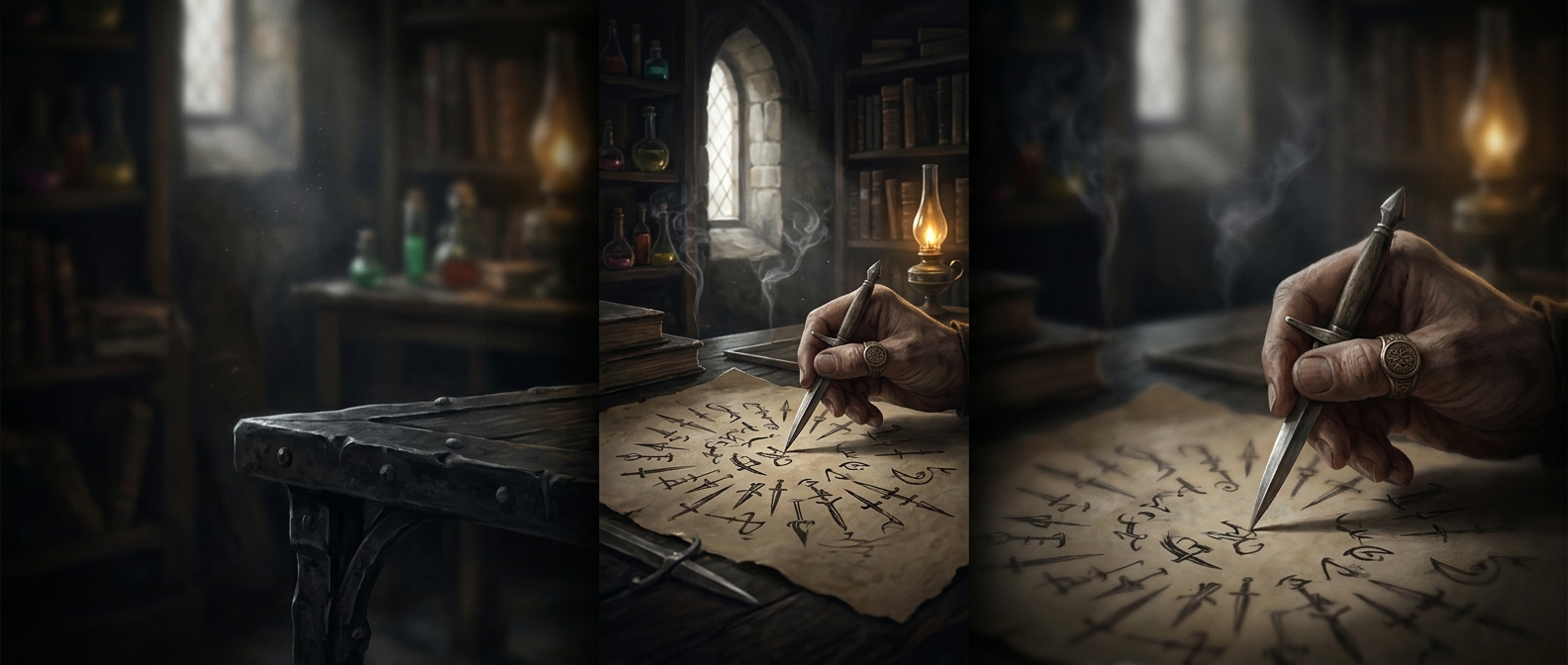
A script built from blade-like marks
The Alphabet of the Magi replaces ordinary letters with distinctive, dagger-shaped signs. It is a substitution alphabet: instead of changing the words or their order, the writer swaps each familiar letter for a different symbol. Someone who knew the key could read the text; to everyone else, a line of signs looked like an unfamiliar script.
Secrecy and magical writing
Paracelsus is associated with the alphabet as a way to encode notes in his esoteric writings. In that setting, unusual lettering did more than make a page hard to read. It marked the material as belonging to specialized magical learning, where names, instructions, and symbols were treated as part of a distinct body of knowledge.
The script’s striking appearance should not be mistaken for a separate spoken language or proof that its contents had supernatural power. Its practical mechanism was simple substitution, while its dagger-like shapes gave the writing an unmistakable visual identity. A reader encountering the marks had to find the alphabet’s correspondences before the words could emerge.