Separation happens through repeated tiny delays
A chromatography column works less like a sieve and more like a long series of brief negotiations. As a sample moves with a mobile phase—a flowing liquid or gas—it repeatedly encounters a stationary phase, a solid or a liquid fixed in place. A molecule that interacts strongly with the stationary phase spends more time held back; one that stays more readily in the mobile phase keeps moving.
These interactions can come from properties such as polarity, which describes how electrical charge is distributed within a molecule. The same chemical does not have to stop permanently: it may stick for a moment, detach, and move on. Across many encounters, small differences in how often components pause add up to different travel times.
A column turns timing into visible bands
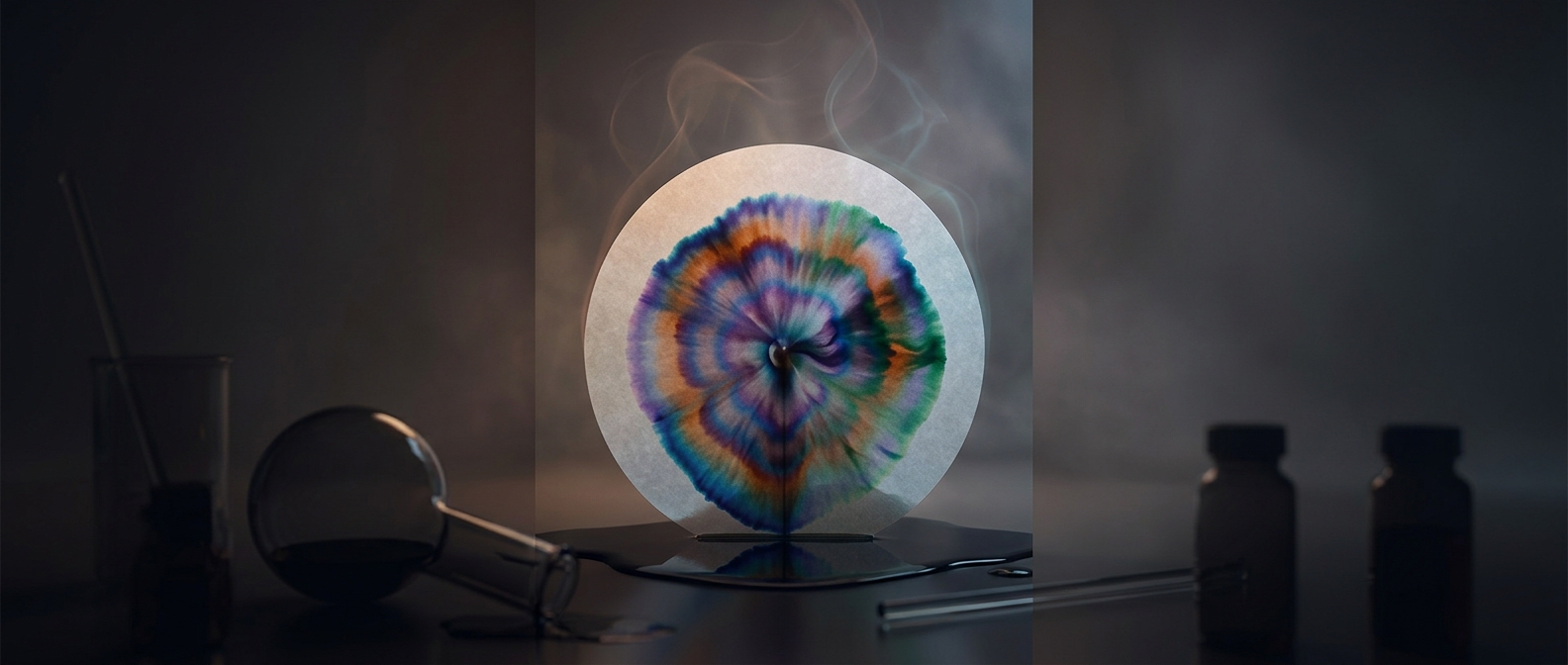
In a column, separated components emerge at different times, often as distinct bands. A detector can record those arrivals, producing a chart called a chromatogram. Each peak marks material reaching the detector; its position helps distinguish components, while its size can indicate how much is present when the method is properly calibrated.
The result depends on the entire setup, not on a chemical having one universal speed. Change the stationary material or the flowing solvent, and the balance of attractions changes. A mixture that separates poorly under one set of conditions may spread into clearer bands under another.
Why the method is useful
That tunability makes chromatography useful both for identifying what is in a sample and for collecting separated substances. In laboratories, it can help distinguish compounds in a complex mixture; on a larger scale, related methods can purify useful ingredients. The practical payoff is that molecules need not look different to be separated: differences in how they interact with two phases can be enough to turn an apparently uniform sample into measurable, distinct components.