How a drop of liquid turns paper into a separator
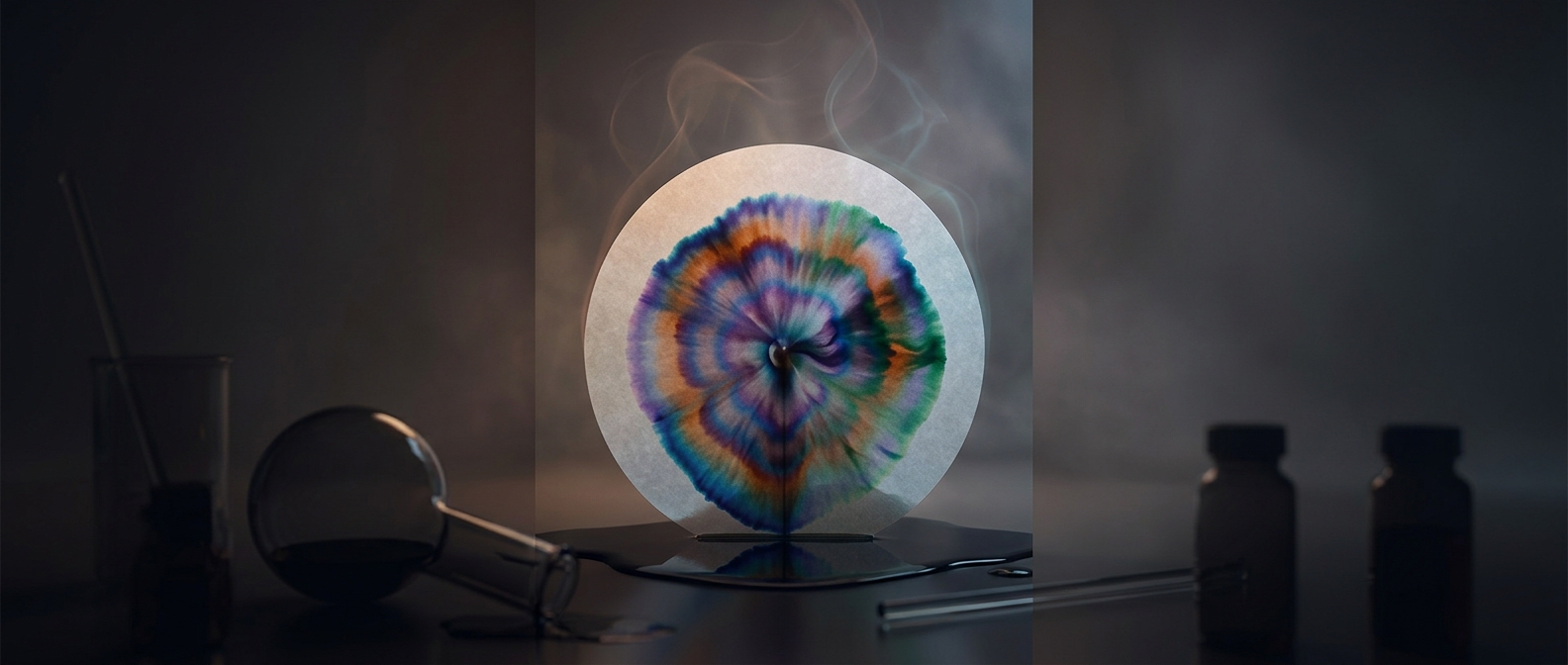
In the 19th century, German chemist Friedlieb Ferdinand Runge explored what he called “capillary pictures”: patterns made when drops of chemical solutions soaked into paper. The paper was more than a surface for displaying color. Its tiny spaces drew liquid outward, while the substances dissolved in that liquid moved along with it.
The crucial observation was that the substances did not all travel equally far. Some clung more strongly to the paper; others stayed more readily in the moving liquid. As the liquid spread, this difference pulled the mixture apart into rings or bands. Runge’s experiments helped reveal a useful principle, though they were not yet the standardized chromatography method used in laboratories today.
The race between paper and liquid
Chromatography works by making mixture components repeatedly divide their allegiance between two places: a stationary phase, which stays put, and a mobile phase, which moves. In paper chromatography, the paper is the stationary phase and a solvent—the liquid carrying the sample—is the mobile phase.
A chemical that sticks to the paper spends more time held back and travels a shorter distance. One that dissolves readily in the solvent is carried farther. Because different chemicals balance those attractions differently, a single moving liquid can spread a mixed sample into distinct marks. The pattern can help identify what is present by comparison with known substances.
From striking patterns to a practical tool
Runge’s colorful experiments made separation visible, but the broader laboratory technique developed later, when chemists turned the same principle into a controlled way to analyze mixtures. The name chromatography—literally, “color writing”—reflects its early association with colored bands, although the method can separate substances that are not visible to the eye.
The desk-side surprise was that paper could do more than absorb a spill: its surface and the moving liquid could sort chemicals according to how each behaved. A simple spreading stain had become a readable map of a mixture.