How a spark became a chemical clue
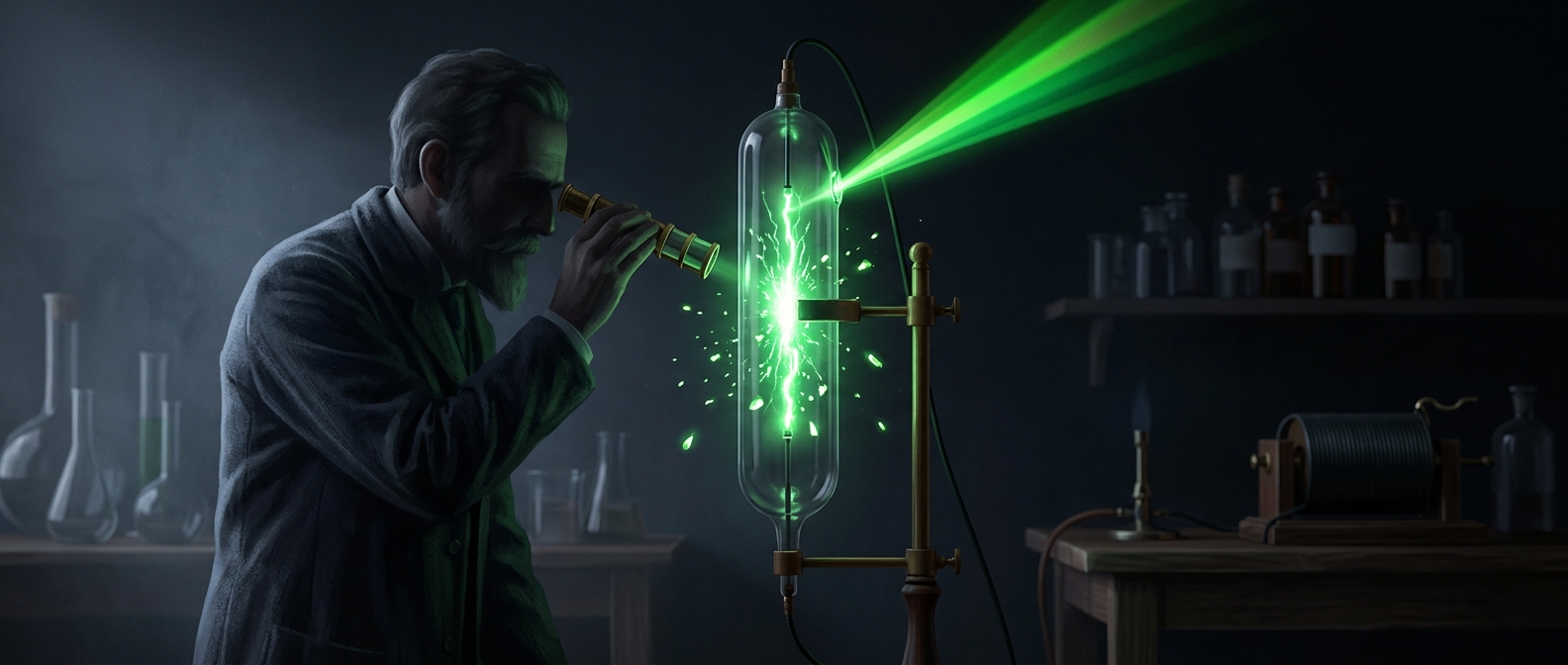
A mineral sample can contain several elements mixed together, and their colors blend when heated. Crookes used a spectroscope—a device that spreads light into its component colors, much like a prism—to make those clues easier to distinguish. Instead of seeing only a green glow, he saw a narrow, unusually bright green line at a particular position in the spectrum.
That line mattered because an element’s atoms do not emit every color equally. When atoms are energized, their electrons can move to higher-energy states. As the electrons return to lower ones, they release light at specific wavelengths. The resulting set of spectral lines acts like a barcode: mixtures may produce overlapping patterns, but a distinctive line can point to an element not yet recognized in the sample.
From an unfamiliar line to thallium
Crookes observed the green line while analyzing material that contained an unknown substance. Its position did not match the spectral patterns he knew, so the color was evidence of something chemically new—not merely an attractive feature of the flame. The method let him detect the element by the light it emitted before he could identify it by sight alone.
He named the element thallium, drawing on a Greek word associated with a green shoot, a nod to the vivid line that had revealed it. The discovery illustrates a change in how chemists could search: instead of relying only on separating and inspecting substances, they could use light as a diagnostic tool. A trace of an element might be too small or too mixed to stand out visibly, yet still leave a measurable signature in a spectrum.